When YouTube fully integrated Shorts into the YouTube Partner Program, it caused a massive gold rush among creators. The promise was simple: generate millions of views with rapid-fire, 60-second vertical videos, and get paid for it.
However, when those first paychecks arrived, many creators were shocked. A video that generated 5,000,000 views might only yield a few hundred dollars. The confusion stems from applying the rules of long-form video monetization to the radically different ecosystem of short-form content.
If you are planning to build a channel around vertical video, you must understand the "Revenue Pool" model. Here is the ultimate breakdown of how YouTube Shorts are monetized, and exactly how to use a YouTube Shorts Earnings Calculator to predict your monthly income.
The Revenue Pool: Why Shorts Pay Differently
In traditional, long-form YouTube videos, the monetization model is straightforward: a viewer clicks your video, an ad plays, and you split the revenue from that specific ad with YouTube (as we discussed in our CPM vs RPM guide).
Shorts do not work this way. Because viewers rapidly scroll through a feed, advertisements are inserted between videos, not attached to one specific creator's video. Therefore, YouTube utilizes a Creator Pool model.
How the Shorts Pool is Calculated:
- Collection: YouTube aggregates all the advertising revenue generated from ads shown in the Shorts Feed across an entire country.
- Music Licensing: A portion of that total pool is deducted to pay music publishers if creators used copyrighted audio tracks in their Shorts.
- Creator Allocation: The remaining pool is distributed to monetized creators based on their percentage of total eligible Shorts views in that country.
- Revenue Split: Finally, creators take home 45% of their allocated share, while YouTube keeps 55%.
Because the revenue is pooled and split based on a percentage of billions of total platform views, the payout per individual view is fractions of a penny.
Calculate Your Exact Shorts Revenue
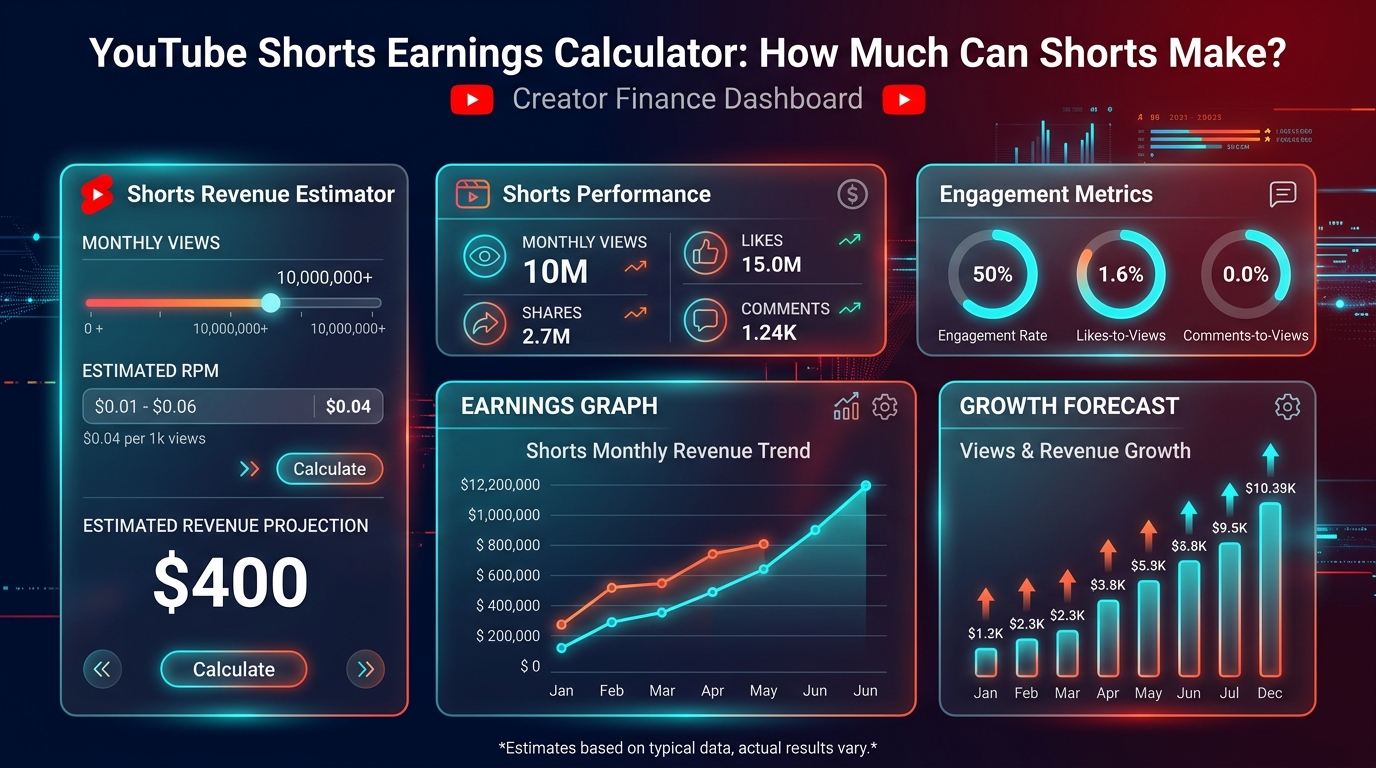
Stop guessing how many views you need to pay your bills. Use our interactive YouTube Earnings Calculator. Simply select "Shorts" as your content type, input your monthly view count, and get an instant, mathematically accurate projection of your expected income.
What is a Normal RPM for YouTube Shorts?
Because of the pooled structure, the Revenue Per Mille (RPM) for Shorts is drastically lower than long-form content. You need massive volume to generate significant AdSense revenue.
Currently, across most Tier 1 countries (like the United States, UK, and Canada), the average RPM for YouTube Shorts ranges from $0.03 to $0.08 per 1,000 views.
| Shorts Views | Estimated Earnings (Low End - $0.03 RPM) | Estimated Earnings (High End - $0.08 RPM) |
|---|---|---|
| 100,000 Views | $3.00 | $8.00 |
| 500,000 Views | $15.00 | $40.00 |
| 1,000,000 Views | $30.00 | $80.00 |
| 10,000,000 Views | $300.00 | $800.00 |
As you can see, a million views on a Short might only buy you a decent dinner. However, the algorithm pushes Shorts much faster and wider than long-form videos. It is incredibly common for a new creator to hit 10 million Shorts views in a month, whereas hitting 10 million long-form views could take years of grinding.
Can You Increase Your Shorts RPM?
Unlike long-form videos where you can manually place mid-roll ads or target specific high-value keywords to artificially raise your RPM, your control over Shorts monetization is limited by the pool system. However, two major factors still apply:
1. Viewer Geography
Just like standard videos, the geographic location of the viewer dictates the size of the initial revenue pool. The US advertising pool is massive; the Indian advertising pool is much smaller. You can check the value of different geographic markets on our Global RPM Data page.
2. Original Audio vs. Licensed Music
If you use a popular trending song from the Shorts Audio Library, YouTube takes a larger cut of your pooled revenue to pay the music label. If your Short uses completely original audio (like you speaking to the camera), you retain a larger share of the pool, which can slightly increase your effective RPM.
The True Value of Shorts: The Funnel Strategy
If the AdSense revenue is so low, why are major creators investing heavily in Shorts? Because they use Shorts as a top-of-funnel marketing tool, not as the final product.
Shorts are the most effective subscriber acquisition tool on the platform. The strategy is simple: Use fast-paced Shorts to capture millions of eyeballs and gain tens of thousands of subscribers. Then, redirect those new subscribers to your 15-minute long-form videos, where the RPM is $10.00 instead of $0.05.
Furthermore, because Shorts reach such a massive audience, they are highly valuable for brand deals. A sponsor might not care about your AdSense RPM; they care that 2 million people are going to see their logo in the first three seconds of your video. A creator with 5 million monthly Shorts views can easily negotiate $2,000 to $5,000 per month in brand sponsorships, rendering the $200 AdSense check a mere bonus.
Frequently Asked Questions
Do I need 10 million views to get monetized with Shorts?
Yes, to qualify for the YouTube Partner Program purely through Shorts, you need 1,000 subscribers and 10 million valid public Shorts views in the last 90 days. Alternatively, you can qualify using the long-form requirement (4,000 watch hours).
Do Shorts views count toward the 4,000 watch hours requirement?
No. Watch time generated from the Shorts Feed does NOT count toward the 4,000 public watch hours needed for traditional monetization.
If someone watches my Short on a desktop computer, does it pay more?
If a Short is watched via standard search or on a desktop channel page (and an ad plays before it), it is monetized like a regular long-form video. However, the vast majority (99%) of Shorts traffic comes from the mobile Shorts Feed, which uses the pooled model.
Why did my Shorts RPM drop to $0.01?
This happens frequently when a Short goes viral globally. If a video initially trends in the US (high RPM) but is suddenly picked up by the algorithm in Tier 3 countries, the massive influx of low-paying views will drag your average RPM down to pennies.
Can I use a calculator to predict my exact payout?
You can estimate it closely. By multiplying your expected views by an average $0.05 RPM using our Earnings Calculator, you will get a realistic projection of your monthly check.
Do Super Thanks work on Shorts?
Yes. Viewers can purchase Super Thanks directly on your Shorts. Because this revenue is not pooled, it goes directly to you (after YouTube's standard 30% cut), offering a great way to boost your overall earnings.
Conclusion
YouTube Shorts offer an unprecedented opportunity for explosive growth, but relying entirely on them for AdSense revenue requires astronomical, consistently viral view counts.
By understanding the Revenue Pool model, you can set realistic financial expectations. Use a calculator to project your baseline AdSense income, but remember that the true power of Shorts lies in leveraging that massive audience. Directing them to your long-form content, building your subscriber base, and securing direct sponsorships are the true methods to making a living from vertical video.