Table of Contents
When amateur creators open YouTube Studio, they look at two things: Subscriber Count and Total Views. If those numbers are green, they are happy. If they are red, they are sad.
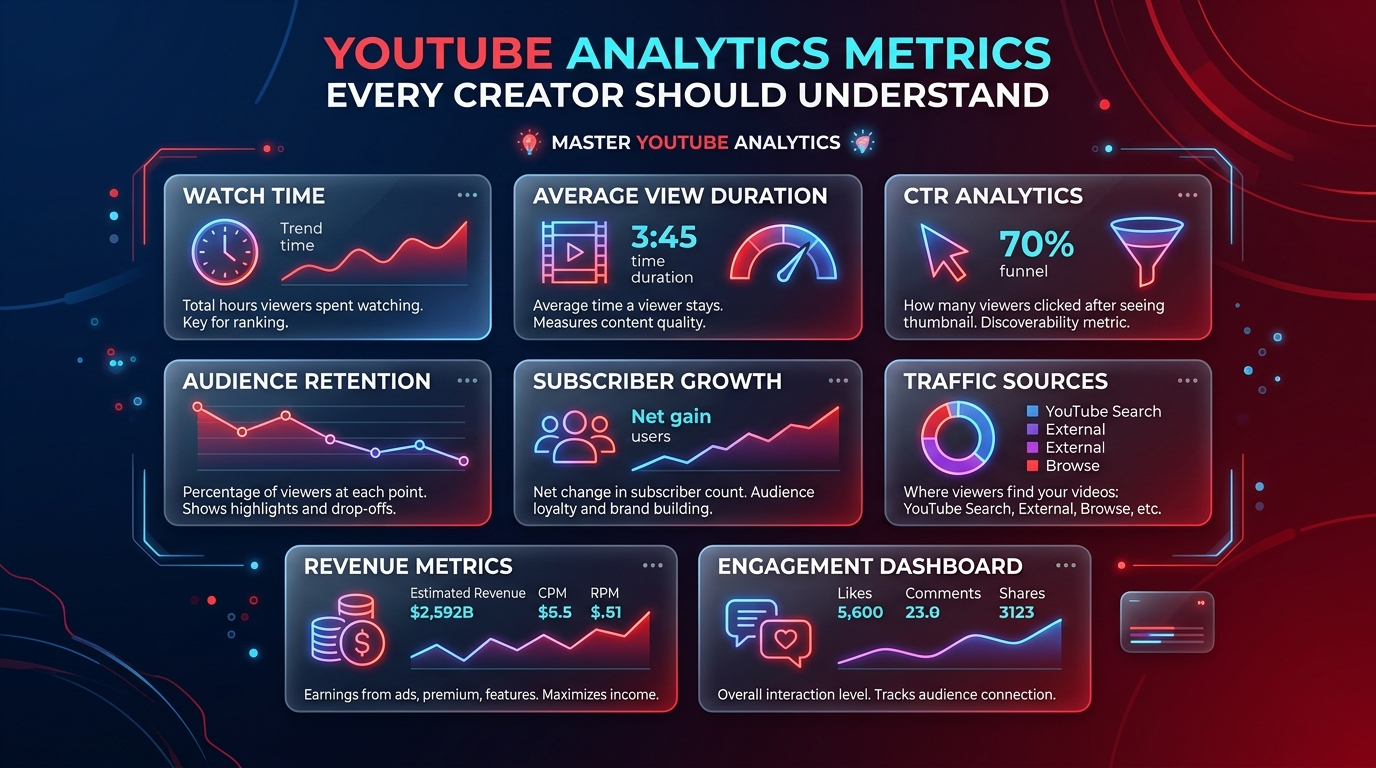
Professional creators do not care about subscribers. They know that subscribers are a vanity metric. If you want to trigger the algorithm to push your videos to millions of people and maximize your AdSense income, you must master the "Holy Trinity" of YouTube Analytics: CTR, AVD, and RPM.
Here is a complete breakdown of the only three metrics you actually need to understand to grow your channel.
1. Click-Through Rate (CTR)
What it is: The percentage of people who saw your video's thumbnail on their screen and actually decided to click on it.
Why it matters: If your video has a 1% CTR, it means YouTube showed your thumbnail to 100 people, and only 1 person cared enough to click. The algorithm will immediately conclude that your video is boring and will stop showing it to new people. The video is dead on arrival.
- Bad CTR: Under 3%
- Good CTR: 5% to 7%
- Viral CTR: 10%+
How to fix it: CTR is entirely determined by your Thumbnail and Title combination. If your CTR is low, your content might be a masterpiece, but no one will ever see it because the packaging failed. Stop spending 20 hours editing a video and only 5 minutes making a thumbnail. The thumbnail is the most important part of the video.
2. Average View Duration (AVD) & Retention
What it is: How long, on average, a viewer stays watching your video before clicking away. It is usually measured as a percentage (Audience Retention).
Why it matters: YouTube's ultimate goal as a company is to keep users on their website for as long as possible so they can serve more ads. If your thumbnail gets a 15% CTR (amazing!), but your viewers leave after 10 seconds (terrible AVD), YouTube will penalize the video as "clickbait."
- Bad Retention: Viewers leaving before the 30-second mark.
- Good Retention: Keeping 50% of the audience past the halfway point of the video.
How to fix it: Look at the retention graph in your analytics. If there is a massive cliff at the beginning, your intro is too slow. Cut the fluff. Optimize your hook. If there are sudden dips in the middle, you are boring the audience. Use pattern interrupts (B-roll, zoom-ins, text) to keep them engaged.
3. Revenue Per Mille (RPM)
What it is: Exactly how much money you take home for every 1,000 views your video generates.
Why it matters: As we have discussed in our RPM vs CPM guide, this metric determines your livelihood. 100,000 views at a $1.00 RPM is $100. 100,000 views at a $10.00 RPM is $1,000. The effort to make the video was the same, but the financial outcome is 10x different.
Track Your RPM Growth
Your RPM will fluctuate wildly based on seasonality and audience geography. Use our YouTube Earnings Calculator to run weekly scenarios. If your analytics show your RPM is dropping, use the calculator to determine exactly how many extra views you need to make up the difference.
The "Session Starts" Metric (Advanced)
While CTR, AVD, and RPM are the core metrics, advanced creators also track "Session Starts." This metric tracks how often your video is the first video a user clicks on when they open the YouTube app.
If your video consistently pulls people onto the platform (triggering a long binge session), the algorithm will treat your channel like royalty, promoting your content relentlessly across the homepage.
Vanity Metrics vs Revenue-Driving Metrics
| Metric | Type | Why It Matters (or Doesn't) |
|---|---|---|
| Subscriber Count | Vanity | Has almost no correlation with views or revenue post-2020 due to algorithm shifts. |
| Total Views (Lifetime) | Vanity | Includes old, low-earning videos. Irrelevant to current channel health. |
| Click-Through Rate (CTR) | Revenue-Driving | A low CTR means your thumbnail/title isn't compelling. Directly limits reach. |
| Average View Duration (%) | Revenue-Driving | Higher retention = more mid-roll ads served = higher RPM. |
| Revenue per Mille (RPM) | Revenue-Driving | The single most important monetisation metric. Tracks your take-home rate. |
Common Mistakes
- Optimising for Views Over Watch Time: A clickbait thumbnail that gets millions of views but a 20% retention rate will actually hurt your channel. YouTube's algorithm distributes a video based on watch time generated, not raw view count.
- Not Checking Traffic Sources: If 70% of your views come from Suggested Videos (someone else's audience), your channel has no loyal audience of its own. Check the Traffic Sources report monthly to ensure your Browse and Search traffic is growing.
Best Practices
- A/B Test Thumbnails: YouTube Studio allows you to run thumbnail A/B tests. Use this feature on every upload to systematically improve your CTR over time, as even a 1% CTR improvement compounds massively at scale.
- Set a Retention Target: Aim to keep your Average View Duration above 40% for videos under 10 minutes, and above 35% for videos over 15 minutes. Videos that consistently hit these benchmarks get amplified by the algorithm.
💰 Translate Metrics Into Money
Once you know your RPM from YouTube Analytics, use the YouTube Earnings Calculator to project your monthly and annual income based on your current growth rate.
Frequently Asked Questions
Why does my CTR drop when my video goes viral?
This is normal and expected! When a video first launches, YouTube shows it to your hardcore subscribers, resulting in a high CTR (e.g., 12%). As it goes viral, YouTube pushes it to a broader, colder audience who doesn't know you. Naturally, fewer of them will click, causing the CTR to average down to 4% or 5%.
Which is more important: CTR or Watch Time?
They operate as a multiplier equation: CTR × Watch Time = Success. However, if forced to choose, raw Watch Time (total minutes watched) is heavily favored by the algorithm for pushing long-form content.
How often does YouTube update these metrics?
View counts and real-time activity update instantly. Deep analytics like Audience Retention take 24-48 hours to process. Revenue (RPM) updates once a day, usually on a 48-hour delay.
Conclusion
Stop checking your subscriber count every hour. It is a metric that no longer dictates your success in the modern YouTube recommendation system.
If you want to treat YouTube like a business, you must act like a data analyst. Study your CTR to improve your packaging. Study your AVD to improve your storytelling. And track your RPM to ensure your business remains profitable.