Table of Contents
One of the most stressful aspects of being a full-time creator is the unpredictability of your paycheck. You might generate 1 million views in November and make $5,000, but when you generate the exact same 1 million views in January, you only make $2,500.
Where did the other half of your money go? Did YouTube steal it? Did the algorithm punish you?
No. Your revenue changes because your RPM (Revenue Per Mille) is a living, breathing metric that fluctuates based on global economics, seasonal ad budgets, and audience behavior. Here is a breakdown of why your income is never the same twice.
1. The Seasonality of Corporate Ad Budgets
As we detailed in our guide on how advertisers bid for ad space, corporations control your paycheck.
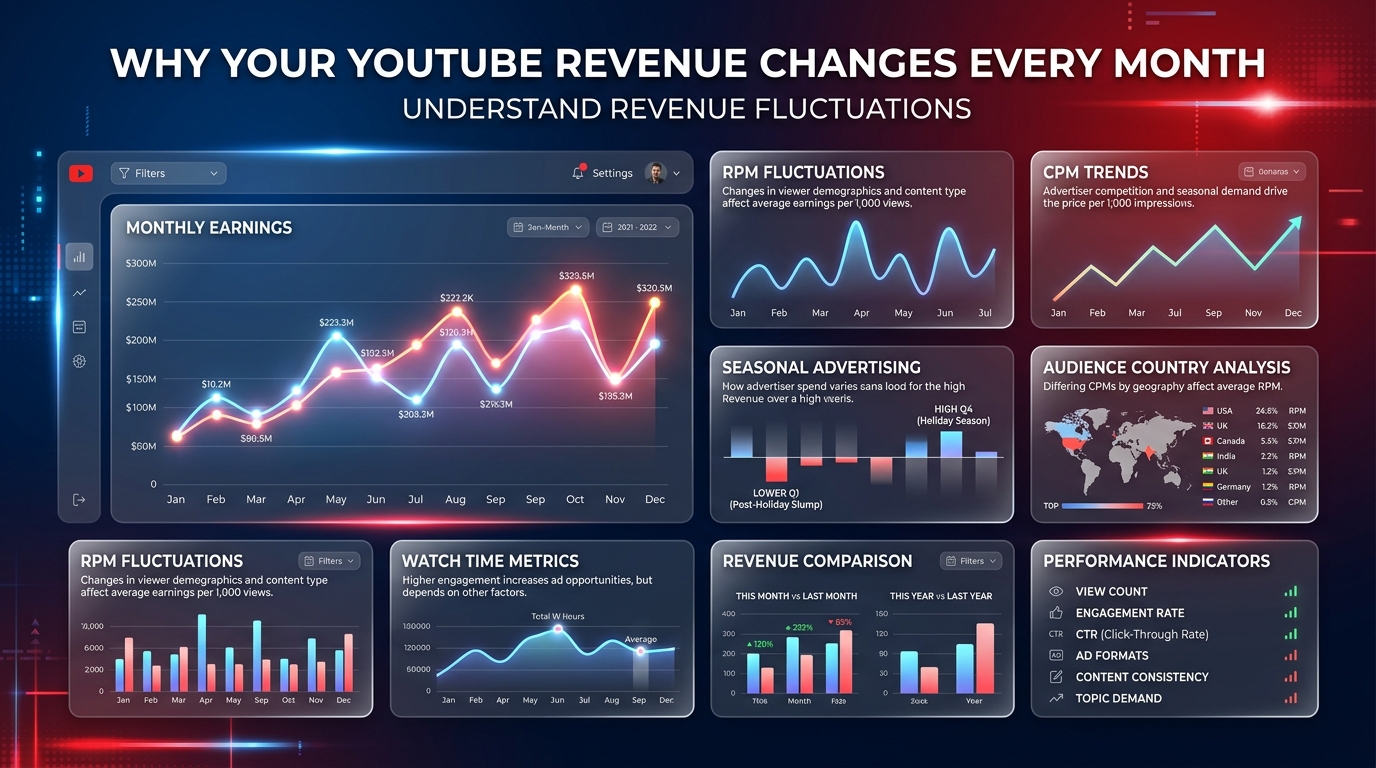
Corporate marketing budgets run on fiscal quarters. This creates predictable, massive swings in your monthly revenue:
- January (The Crash): After massive holiday spending, companies slash their budgets to regroup for the new year. Auction competition dies, and RPMs crash. Expect a 30-40% drop in revenue compared to December.
- End of Quarters (March, June, September): Marketing managers realize they have unspent budget for the quarter. If they don't spend it, they lose it next quarter. They aggressively dump money into YouTube ads in the last two weeks of the month, causing your RPM to temporarily spike.
- November & December (The Gold Rush): Black Friday and Christmas shopping drive advertisers into a bidding war. Companies will pay astronomical rates to get their products in front of consumers. This is when your RPM will hit its yearly peak.
Factor in Seasonality
When using our YouTube Earnings Calculator to project your yearly income, do not use your December RPM. It will give you a false sense of security. Always use your April or August RPM as your "baseline" for accurate financial forecasting.
2. Shifts in Audience Demographics
Not all views are created equal. If a video unexpectedly goes viral in a developing nation, your total views will skyrocket, but your overall channel RPM will plummet.
For example, if your standard audience is 80% US viewers, your RPM might be $6.00. If an algorithm shift pushes your newest video heavily to viewers in India or Brazil (where advertiser budgets are much smaller), that video's RPM might be $1.50.
If you see a sudden drop in revenue despite high view counts, immediately check the "Geography" tab in your YouTube Analytics. A shift toward lower-RPM countries is almost always the culprit.
3. The "Invalid Traffic" Filter
Occasionally, you will look at your estimated revenue on Tuesday, and by Thursday, the number has dropped by $50. This is YouTube's "Invalid Traffic" filter at work.
Throughout the month, YouTube audits your views to ensure advertisers are not paying for bots, ad-blockers, or accidental clicks. If they detect a spike in spam views, they remove the revenue associated with those views to protect the advertisers. This results in retroactive revenue deductions.
4. Changes in Content Format
Did you start uploading more YouTube Shorts recently? Because Shorts operate on a pooled revenue model, their RPM is drastically lower than long-form content (often around $0.05 per thousand views).
If your total monthly views stayed the same, but the ratio shifted (e.g., you got fewer long-form views and more Shorts views), your total revenue will drop significantly. You cannot compare long-form AdSense to Shorts AdSense; they are entirely different economies.
YouTube Monthly Revenue Patterns
| Month | Typical RPM Trend | Reason |
|---|---|---|
| January | 📉 Lowest of year | Advertisers reset annual budgets; Q4 budgets exhausted |
| February | 📈 Modest recovery | Valentine's Day campaigns begin |
| July – August | ➡️ Flat to slight decline | Summer ad spending dip in many categories |
| October | 📈 Strong growth | Q4 budget deployment begins; Black Friday prep |
| November – December | 🚀 Peak of the year | Maximum advertiser competition drives CPM sky-high |
Common Mistakes
- Publishing Less in Q3 Because Revenue Is Lower: The videos you upload in August will be well-indexed by October, positioning you to capture the full Q4 revenue surge. Slowing down in summer directly hurts your Q4 earnings.
- Comparing Month-to-Month in Isolation: Your January RPM will almost always be lower than your December RPM. The correct comparison is January 2026 vs January 2025 — year-over-year data reveals your true channel growth.
Best Practices
- Create Timeless Content in Slow Months: During low-RPM months, focus on producing "evergreen" content that will continue to generate views — and revenue — for years. Tutorials, how-to guides, and product reviews all qualify.
- Save in Q4: Treat Q4 income as a bonus, not a baseline. Many creators burn through December's inflated revenue and are shocked when January pays a fraction of that amount.
📊 Simulate Your Q4 Earnings
If your average monthly views are 500,000 at a $4 RPM, but Q4 bumps your RPM to $8, how much extra will you earn? The YouTube Earnings Calculator lets you model this in seconds.
Frequently Asked Questions
Is there any way to prevent the January revenue crash?
You cannot stop the RPM drop, but you can prepare for it. Smart creators secure fixed-rate brand sponsorships for January and February to offset the AdSense crash, or they launch their own digital products (courses, merch) during this time.
Does getting a "Yellow Icon" (Limited Ads) ruin revenue for the whole month?
It ruins the revenue for that specific video. If your video is flagged as not advertiser-friendly, premium brands opt out of bidding on it, dropping its RPM to near zero. Ensure you follow all advertiser-friendly guidelines to keep your channel in good standing.
Why did my revenue drop on a holiday weekend?
People are spending time with their families, not watching YouTube. Overall traffic on the platform drops on major holidays (like Thanksgiving or the 4th of July), resulting in fewer ad impressions and lower daily earnings.
Conclusion
Volatility is the price of admission for being a YouTube creator. Your AdSense check will never be a flat, predictable salary.
By understanding the seasonal shifts of corporate ad budgets and monitoring your geographic analytics, you can stop panicking over revenue drops. Build an emergency fund during the high-earning months (November/December) to comfortably weather the inevitable crashes (January/February), and treat your channel like the dynamic business it is.