Table of Contents
- 1. The Real-Time Bidding (RTB) Auction
- 2. Brand Campaign Objectives
- 3. B2B vs B2C Advertising Budgets
- 4. Seasonal Advertising Budgets
- 5. Audience Targeting Parameters
- 6. Advertiser Bidding Comparison Table
- 7. Real-World Advertiser Scenarios
- 8. Common Mistakes Advertisers Make
- 9. Best Practices for Media Buyers
While content creators obsess over their RPM (Revenue Per Mille), the true financial engine of YouTube operates on the other side of the screen. Advertisers utilizing Google Ads dictate the flow of billions of dollars across the platform. The rates they pay—known as CPM (Cost Per Mille)—are not arbitrary. They are the result of highly sophisticated algorithmic bidding systems, strict marketing budgets, and complex corporate campaign objectives.
To truly understand the programmatic advertising ecosystem, we must analyze how media buyers approach YouTube advertising, calculate Customer Acquisition Costs (CAC), and configure their bids inside the Google Ads platform.
The Real-Time Bidding (RTB) Auction
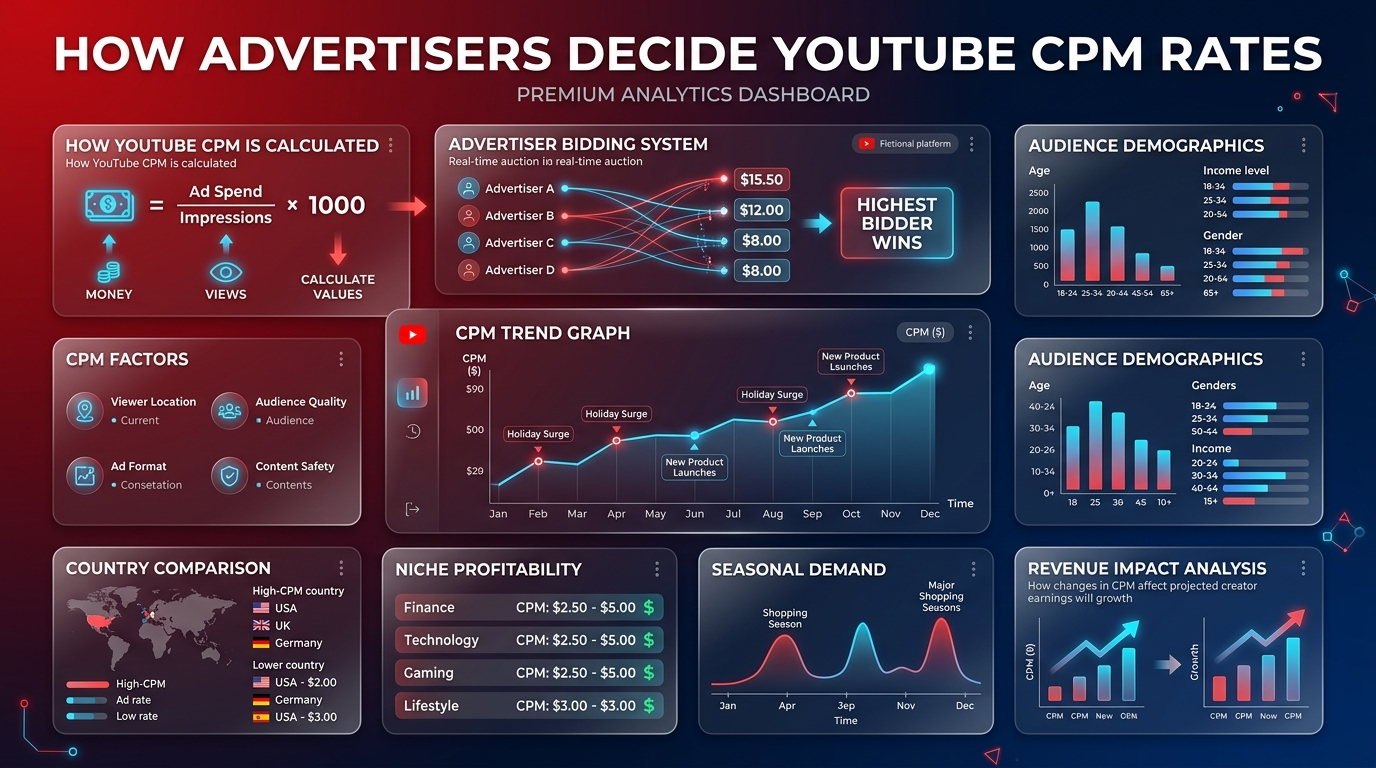
YouTube does not sell advertising inventory at fixed menu prices. Instead, it relies on a Real-Time Bidding (RTB) auction system. Every time a user clicks on a video, an instantaneous micro-auction occurs.
Google's ad server broadcasts the available impression along with anonymized data about the viewer (demographics, recent search history, predicted intent). Advertisers' algorithms evaluate this data in milliseconds. If the viewer matches an advertiser's target persona, their bid is submitted into the auction.
The advertiser with the highest bid wins the placement, paying precisely one cent more than the second-highest bidder (a second-price auction model). This system ensures that CPM rates organically reflect the exact market demand for any specific viewer at any specific second in time.
For more technical details on the auction system, you can refer to the official Google Ads Auction documentation.
Brand Campaign Objectives
CPM rates fluctuate wildly depending on what the advertiser is actually trying to achieve. When configuring a campaign in Google Ads, media buyers must select an objective, which directly informs how aggressively the algorithm will bid.
- Brand Awareness (Low CPM): Fortune 500 companies (like Coca-Cola or Ford) run massive campaigns simply to keep their brand top-of-mind. Because they just want raw impressions and don't care about immediate clicks, they set very low maximum CPM bids. They win auctions only when high-bidding competitors are absent.
- Direct Response / Lead Generation (High CPM): A software company looking for software demo signups cares deeply about conversion. They use "Maximize Conversions" or "Target CPA" (Cost Per Action) bidding. Because they need immediate, high-intent action, the Google algorithm will bid aggressively—often pushing CPMs to $50 or $100—to secure placements in front of high-converting audiences.
B2B vs B2C Advertising Budgets
The most profound divide in the digital advertising market is between Business-to-Consumer (B2C) and Business-to-Business (B2B) marketing.
B2C advertisers typically sell low-to-medium ticket items: $20 t-shirts, $15 video games, or $50 cosmetics. Because their profit margins per unit are tight, their Customer Acquisition Cost (CAC) must remain low. A mobile gaming app cannot afford a $10 CPM because they only make $1.50 per user.
Conversely, B2B advertisers sell enterprise solutions. A cloud infrastructure provider might sell a contract worth $50,000 annually. Their CAC can comfortably exceed $500. When these advertisers enter the YouTube auction targeting IT professionals, their algorithmic bidding limits are astronomically high. They will comfortably bid $80 CPMs to ensure their ads dominate the B2B tech space.
Seasonal Advertising Budgets
Corporate advertising budgets operate on rigid quarterly schedules, causing massive, predictable swings in global CPM rates.
In Q1 (January to March), corporations are planning their annual spend, resulting in cautious, low bidding. By Q4 (October to December), the dynamic completely reverses. Companies are attempting to exhaust their remaining annual marketing budgets (the "use it or lose it" corporate rule) while simultaneously competing for the lucrative Black Friday and Holiday shopping surge.
During the final weeks of Q4, B2C advertisers dramatically increase their maximum bids, creating a hyper-competitive auction environment that temporarily doubles or triples standard CPM rates across the platform.
Audience Targeting Parameters
Advertisers don't bid blindly on content; they bid on audiences. Google Ads allows media buyers to layer multiple targeting parameters:
- In-Market Audiences: Google tracks user search behavior to determine if someone is actively researching a purchase (e.g., "users searching for auto insurance"). Advertisers bid a massive premium for in-market viewers.
- Geographic Location: Advertisers prioritize Tier 1 countries (US, UK, Canada, Australia) because the purchasing power in these regions yields higher Return on Ad Spend (ROAS).
- Household Income: Luxury brands can restrict their ads to the top 10% of household incomes in specific zip codes.
When multiple tight targeting parameters overlap on a single viewer, the resulting auction competition drives the CPM for that specific impression to premium levels.
Advertiser Bidding Comparison Table
| Advertiser Profile | Target Audience | Campaign Goal | Typical Bidding Strategy | Expected CPM Range |
|---|---|---|---|---|
| Mobile Game Dev | Teens, Gamers (B2C) | App Installs | Target CPI (Cost Per Install) | $2 - $6 |
| Retail Clothing | Adults 18-35 (B2C) | E-commerce Sales | Target ROAS | $5 - $12 |
| Auto Insurance | Adults 25-55, In-Market | Quote Requests | Target CPA | $15 - $35 |
| Enterprise SaaS | IT Managers (B2B) | Lead Generation | Maximize Conversions | $40 - $100+ |
Real-World Advertiser Scenarios
Scenario 1: The Wasted Budget. A local restaurant sets up a YouTube campaign but fails to utilize strict geographic targeting. They bid $10 CPM and accidentally burn through $5,000 showing ads to viewers three states away. Their ROAS is zero, and they churn out of the platform.
Scenario 2: The Precision B2B Strike. A cybersecurity firm wants to reach Chief Information Security Officers (CISOs). They utilize custom intent audiences based on users who recently searched for specific compliance regulations on Google. They set their Target CPA at $150. Because the audience is tiny but highly lucrative, their ads win every auction against cheaper competitors, securing a $75 CPM. They spend $20,000 but close two $150,000 contracts.
Common Mistakes Advertisers Make
- Broad Targeting: Trying to reach "everyone" destroys ROAS. Broad targeting forces advertisers to bid low CPMs, which relegates their ads to low-quality, generic content.
- Ignoring Placement Exclusions: Failing to exclude children's content or low-quality entertainment channels results in millions of wasted impressions on viewers with zero purchasing power.
Best Practices for Media Buyers
- Use Custom Segments: Combine search intent data with YouTube targeting to reach users at the exact moment they are ready to purchase.
- Separate Brand and Direct Response: Never mix awareness objectives with conversion objectives in the same campaign. Use distinct budgets and distinct bidding strategies (vCPM for awareness, Target CPA for conversions).
Conclusion
YouTube CPM is not an arbitrary metric created by the platform; it is the mathematical output of thousands of advertisers competing for valuable consumer attention in real-time. By understanding how B2B budgets, seasonal pressures, and sophisticated Google Ads targeting tools function, the volatility of digital ad rates becomes entirely predictable.
If you are managing ad spend or analyzing market rates, ensure your budget aligns with your target demographic's market value. For publishers and creators wanting to analyze these advertiser budgets from the receiving end, use the ChafikTech YouTube Earnings Calculator to model how these CPM fluctuations impact final channel revenue.