Table of Contents
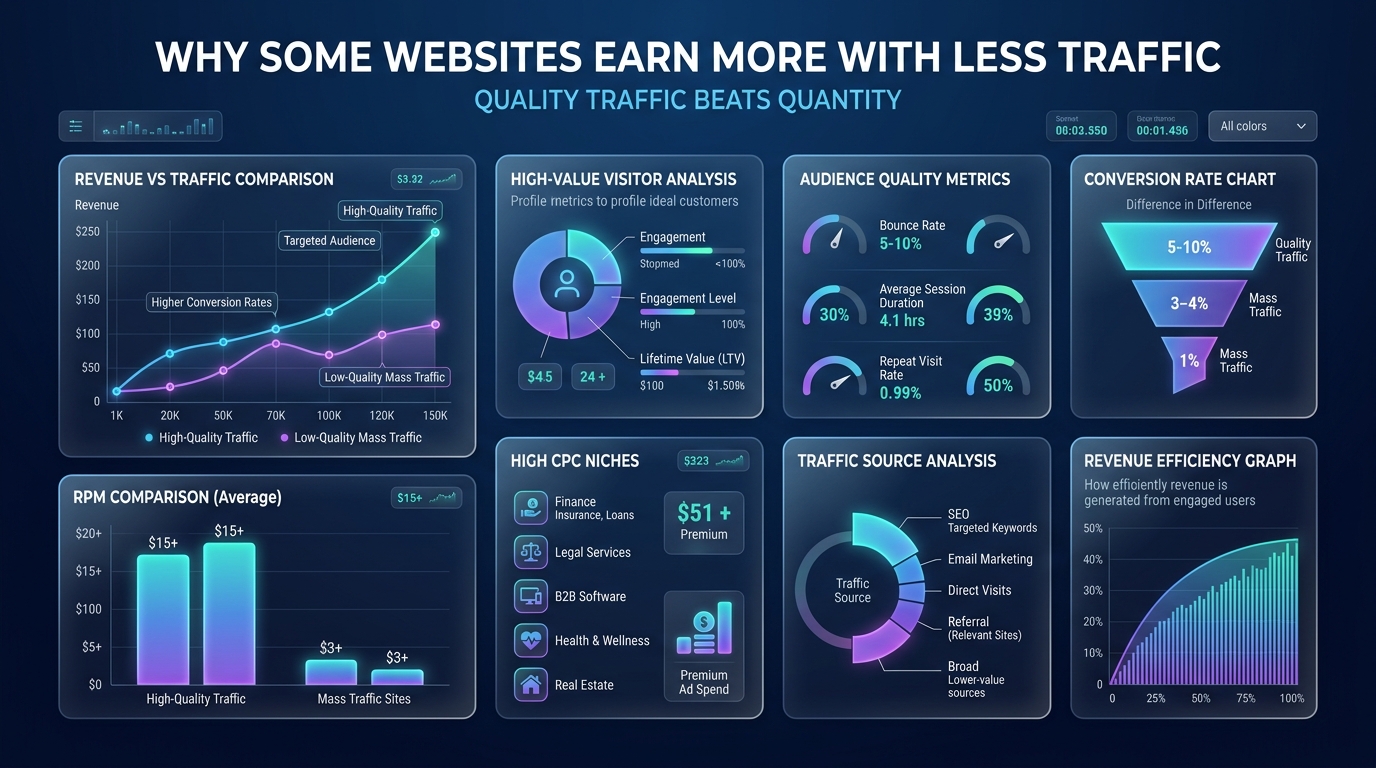
Imagine showing your AdSense earnings to another blogger who brags about having 500,000 monthly pageviews. They scroll down and see your revenue — three times higher than theirs — despite you only having 40,000 monthly pageviews. Their jaw drops.
This is not a myth. It happens constantly in the publishing world, and it comes down to one fundamental principle that separates amateur bloggers from professional media publishers: Traffic quality beats traffic quantity every single time.
The Three Dimensions of Traffic Quality
1. Search Intent: The Most Critical Factor
Not all search queries are equal. Search Intent is the underlying goal a user has when they type something into Google. There are four types:
- Informational: "What is cloud computing?" — The user wants to learn. Low purchase probability.
- Navigational: "AWS login" — The user is going to a specific site. Zero value to you.
- Commercial Investigation: "Best cloud hosting for small business" — The user is comparing options before buying. High value.
- Transactional: "Buy cloud hosting monthly plan" — The user is ready to purchase RIGHT NOW. Maximum value.
A website that exclusively targets Commercial and Transactional keywords will earn 5x to 10x more per visitor than a website that only creates Informational content. Advertisers know that a user searching with commercial intent is moments away from a purchase, and they bid ferociously for that attention.
2. Audience Geography: The Revenue Multiplier
As explored in our deep-dive on highest paying AdSense countries, a single US visitor is worth approximately 10 to 15 times more than a visitor from a Tier 3 country. A website with 20,000 US visitors will comfortably outperform a competitor website with 150,000 visitors spread globally.
3. Session Depth: Visitors Who Binge
A visitor who reads one article and leaves generates one set of ad impressions. A visitor who reads five articles in a row generates five sets. As we covered in our guide on pageviews vs visitors, a deeply engaged, "sticky" audience multiplies your revenue without requiring any additional traffic at all.
Visualize the Quality Gap
Open our Website AdSense Calculator. Run this comparison: Input 200,000 monthly pageviews at a $2.00 RPM (high-volume, low-quality traffic). Then run 30,000 pageviews at a $30.00 RPM (low-volume, high-quality finance traffic). The results will permanently shift how you think about growing your website.
The "1,000 True Fans" Website Strategy
In 2008, Kevin Kelly famously wrote that a creator only needs 1,000 true fans to make a living. For website publishers, this concept maps perfectly to revenue optimization.
A website with 5,000 highly loyal monthly readers who trust your recommendations, click your affiliate links, and return regularly to read new content is more valuable as a business than a viral site with 500,000 one-time visitors who bounce after 15 seconds.
Loyal readers have high ad viewability rates (they scroll deep into articles, ensuring ads are actually seen), high session depths (generating multiple pageviews per visit), and high return visitor rates (which signal quality to Google's algorithm, improving your search rankings further).
How to Build a High-Quality Audience
- Target Long-Tail, High-Intent Keywords: Instead of chasing "best laptop" (informational, high competition), target "best laptop for video editing under $1200" (commercial investigation, lower competition, higher CPC).
- Build Topical Authority Clusters: Publish 15 interconnected articles on one narrow subject. Google will begin to treat you as the definitive expert, pushing your content to Tier 1 audiences globally.
- Prioritize US & UK English SEO: Consciously structure your keyword research around topics that are primarily searched by English-speaking, high-income demographics.
- Improve Time-on-Page: Use videos, comparison tables, and interactive elements (like calculators) to keep users engaged longer, increasing both ad viewability and session depth.
Diagnose Your Traffic Quality Now
Before spending another month publishing content, get a clear picture of your current audience quality. Check our RPM Data by Country page to benchmark your current RPM against your niche average. If your RPM is underperforming even for a low-quality niche, run the AdSense Audit Tool to identify any technical issues suppressing your earnings. And if you are new to AdSense, first confirm your site is eligible using the AdSense Eligibility Checker.
Revenue Efficiency: Volume vs Value Niches
| Website Type | Monthly Pageviews | Avg. Page RPM | Est. Monthly Revenue |
|---|---|---|---|
| Gaming Meme Blog | 500,000 | $1.50 | $750 |
| Cooking / Recipes Blog | 200,000 | $8.00 | $1,600 |
| Personal Finance Blog | 80,000 | $30.00 | $2,400 |
| B2B SaaS Review Site | 30,000 | $60.00 | $1,800 |
Common Mistakes
- Chasing Viral Traffic: Writing about trending celebrity gossip or viral memes drives enormous short-lived traffic spikes. But these readers have zero purchase intent, and advertisers know it. The RPM is catastrophically low.
- Ignoring Affiliate Opportunities: A personal finance site with 80,000 pageviews that runs only AdSense is leaving huge money on the table. A single credit card affiliate link can pay $100–$300 per approved application.
Best Practices
- Target Bottom-of-Funnel Keywords: Keywords like "best [product] for [specific use case]" or "[Product A] vs [Product B]" attract people who are ready to buy. These users generate far higher RPMs because advertisers bid aggressively to reach them.
- Add High-CPC Content to Low-CPC Sites: If you run a food blog, add a section covering kitchen equipment reviews or meal planning apps. These adjacent topics attract higher-CPC ads to your entire domain.
🔢 Test the RPM Difference
See how dramatically niche RPM changes your revenue without needing more traffic. Enter 100,000 pageviews at $5 RPM, then at $25 RPM, into the Website AdSense Calculator to see the 5x revenue difference.
Frequently Asked Questions
Q: If traffic quality matters so much, how do I measure it objectively?
A: Your Page RPM is the most direct measure of traffic quality. A high RPM proves that advertisers are competing aggressively for your audience. Supplement this with Google Analytics data: check average session duration, pages per session, and the percentage of traffic from Tier 1 countries.
Q: Can I improve traffic quality without changing my niche?
A: Yes. Audit your existing content and identify which articles attract the highest-RPM traffic in your AdSense dashboard. Double down on those topics — write more content in that exact sub-niche. Delete or de-index thin, low-RPM content that dilutes your overall audience quality score.
Q: What is the "audience value" concept used by premium ad networks?
A: Premium networks like Mediavine and Raptive evaluate your site based on audience engagement signals: time-on-page, return visitor rate, pages per session, and geographic quality. A site with 50,000 highly engaged sessions per month will earn significantly more than a site with 50,000 low-engagement sessions.
Q: Does reducing my bounce rate actually increase my RPM?
A: Indirectly. A lower bounce rate means more pages per session (more ad impressions) and longer time-on-page (higher viewability). Both factors increase the total revenue generated per visitor, which mathematically raises your effective RPM even if the per-page RPM stays constant.
Q: Should I remove low-performing articles from my website?
A: Articles that get zero traffic and zero revenue should be either improved significantly or removed (301 redirected). Thin content dilutes your domain's perceived expertise and can drag down rankings for your high-performing articles. Quality curation is as important as quality creation.
Q: Is it better to have 100 focused articles or 500 general articles?
A: For revenue optimization, 100 deeply focused, high-intent articles in a premium niche will nearly always outperform 500 scattered general articles. Google's Helpful Content System rewards depth and topical authority over sheer volume.
Q: How do I identify which of my existing articles attract high-value traffic?
A: In AdSense, go to Reports → Pages. This shows you the RPM generated by each individual URL on your site. Sort by RPM descending to immediately see which pages attract the highest-paying advertisers. These are your golden assets — protect and expand on these topics.
Q: Can a single high-RPM article sustain a full-time income?
A: Theoretically yes, but it is extremely risky. A single article can lose its ranking overnight due to a Google algorithm update. Sustainable income requires a portfolio of 30 to 100+ high-RPM articles across multiple related topics, so no single ranking change can devastate your income.
Conclusion
Stop measuring your success in raw pageviews. Start measuring it in revenue per thousand pageviews (RPM). If your RPM is growing, it means the quality of your audience is improving — and that is the only metric that ultimately translates into sustainable, full-time income from your website.