Table of Contents
For modern creators, the battle lines have been drawn. On one side, the traditionalists champion 15-minute, highly produced essays. On the other side, the new wave pushes out three 60-second vertical videos every single day.
The question that haunts every creator planning their content calendar is simple: "Which format is actually going to pay my bills?"
While we have previously broken down exactly how Shorts revenue is calculated, looking at the two formats in a vacuum doesn't tell the whole story. If you are trying to decide where to invest your editing time and production budget, you need to understand the head-to-head math, the lifespan of the content, and the hidden costs of virality.
The Raw Math: RPM Head-to-Head
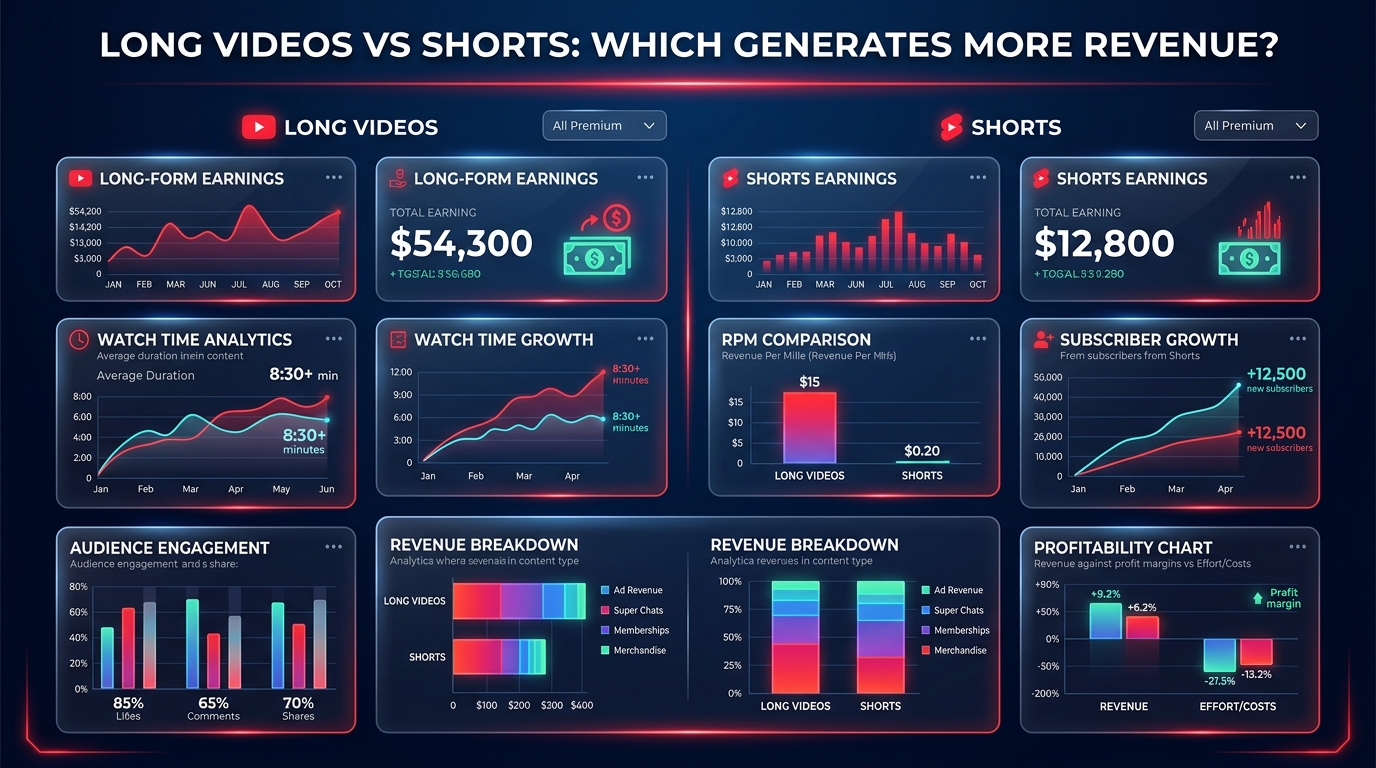
When it comes to direct programmatic AdSense revenue, this is not a fair fight. Long-form video completely obliterates short-form video on a per-view basis.
Because long-form videos allow for targeted pre-roll ads and multiple mid-roll ad placements, the advertiser bidding is aggressive and highly specific. Shorts, conversely, rely on a diluted revenue pool model where an ad is swiped past in a fraction of a second.
| Format | Average RPM (Per 1,000 Views) | Earnings for 1 Million Views |
|---|---|---|
| Long-Form (8+ minutes) | $4.00 - $15.00+ | $4,000 - $15,000+ |
| Shorts (Vertical, under 60s) | $0.03 - $0.08 | $30 - $80 |
The math is stark: It takes roughly 100 to 200 Shorts views to equal the revenue of a single long-form view. If you are optimizing purely for AdSense, a 12-minute video is vastly superior.
Compare Formats Instantly
Don't just take our word for it. Open our YouTube Earnings Calculator. Input 1 million views on the "Long-Form" setting, note the revenue, and then switch the toggle to "Shorts". The massive drop in the projection will immediately clarify the financial difference.
Effort vs. Reward: The Algorithm's Push
If long-form pays so much more, why is anyone making Shorts? Because generating 1 million views on a 15-minute documentary is incredibly difficult, while generating 1 million views on a trendy Short is comparatively easy.
The YouTube algorithm actively feeds Shorts to millions of users on the mobile app. A brand-new channel with zero subscribers can post a Short and receive 50,000 views in an hour. If that same zero-subscriber channel posted a 15-minute video, it might get 5 views in a week.
While the long-form video has a higher potential value, the Short provides an immediate volume advantage. For new creators who are trying to project their income before monetization, the explosive view counts of Shorts provide the necessary algorithmic momentum to get noticed.
The Lifespan: Evergreen vs. Disposable
Revenue is not just about the first 48 hours; it is about the long tail.
The Lifespan of a Short
Shorts are highly disposable. They experience massive spikes in traffic—sometimes millions of views over a weekend—and then the algorithm drops them completely. They rarely receive organic search traffic. A Short that made $50 in its first week will likely make $0 next year.
The Lifespan of Long-Form
Long-form videos are evergreen assets. A well-optimized, 10-minute tutorial on "How to fix a leaking sink" will appear in Google and YouTube search results for years. It might only get 100 views a day, but at a $10 RPM, that video generates $30 every single month for five years straight, entirely passively. A library of 100 long-form videos creates a highly stable, predictable monthly salary.
Sponsorships: The Great Equalizer
AdSense is only half the battle. When it comes to direct brand sponsorships, the dynamics shift significantly.
While long-form videos still command higher sponsorship rates (brands love 60-second dedicated mid-roll reads), Shorts creators leverage sheer volume. A sponsor paying for an integration in a Short knows they are buying millions of rapid impressions. Because of the viral nature of Shorts, creators with massive daily viewership can routinely charge $2,000 to $5,000 for a single branded Short, making up for their lack of AdSense.
The Ultimate Strategy: The "Hybrid" Channel
The most profitable creators on YouTube in 2026 do not choose between the two formats; they master both. This is known as the Hybrid Strategy.
- Shorts as the Top of the Funnel: You produce high-volume, highly engaging Shorts. The goal is not to make AdSense money here. The goal is to capture algorithmic virality and rapidly convert viewers into subscribers.
- Long-Form as the Monetization Engine: Once a week, you post a deeply researched, 15-minute long-form video. The thousands of subscribers you gained from your Shorts are notified. A percentage of them click through to the long-form video.
- The Profit: Those long-form viewers are now watching mid-roll ads, generating massive $10+ RPMs, and turning your viral momentum into sustainable, high-paying revenue.
Revenue Comparison: Shorts vs Long-Form
| Format | Typical RPM | Revenue per 1 Million Views | Primary Value to Channel |
|---|---|---|---|
| YouTube Shorts (< 60s) | $0.02 - $0.07 | $20 - $70 | Rapid subscriber growth & brand awareness |
| Standard Video (3-7 mins) | $2.00 - $5.00 | $2,000 - $5,000 | Stable baseline AdSense income |
| Long-Form (8+ mins) | $4.00 - $12.00+ | $4,000 - $12,000+ | Maximum ad revenue via mid-rolls |
Common Mistakes
- Expecting Shorts to Pay the Bills: Many creators get a viral Short with 10 million views and expect a massive payout, only to be disappointed by a $400 check. Shorts are for reach, not direct AdSense monetization.
- Failing to Convert Shorts Viewers: If you don't use the "Related Video" feature on your Shorts to funnel viewers to a long-form video, you are wasting the traffic.
Best Practices
- The Funnel Strategy: Use Shorts as the top of your funnel. Create highly engaging Shorts that tease a broader topic, and link directly to a 10-minute deep-dive video where the real revenue is generated.
- Repurpose Long-Form Content: Don't create Shorts from scratch if you don't have to. Clip the 3 most engaging 30-second segments from your latest long-form video and upload them throughout the week.
💸 See the Math for Yourself
Curious how a 10-minute video with a $6 RPM compares to a Short with a $0.05 RPM? Use the YouTube Earnings Calculator to simulate both scenarios side-by-side.
Frequently Asked Questions
Do Shorts cannibalize my long-form views?
Initially, there was a fear that Shorts audiences had short attention spans and wouldn't watch long videos. However, YouTube has vastly improved its recommendation bridge. If someone enjoys your Short, the algorithm is now highly likely to recommend your long-form videos to them on their homepage.
Can I just cut my long video into 10 Shorts?
Yes, "clipping" is a popular strategy. However, a clip taken directly from a horizontal video often feels clunky. The best strategy is to script your long video, and then film a dedicated, fast-paced vertical summary specifically designed for the Shorts format.
Which format is better for affiliate marketing?
Long-form is vastly superior. In a long video, you have the time to thoroughly review a product, build trust, and verbally direct the viewer to click the link in the description. Shorts move too fast for high-converting affiliate sales.
Will YouTube ever increase the RPM for Shorts?
The pool model makes significant increases difficult. As more creators make Shorts, the revenue pool is divided into smaller and smaller slices. Don't expect Shorts to ever rival long-form CPM.
Is it worth making long-form if I have zero subscribers?
Yes. Long-form videos build deep parasocial relationships with your audience and rank in search engines. Shorts might get you recognized, but long-form content gets you remembered.
Conclusion
Pitting long videos against Shorts is like comparing a billboard to a textbook. They serve entirely different purposes in a creator's business model.
If you need explosive growth, rapid subscriber acquisition, and immediate algorithmic reach, Shorts are unparalleled. However, if your goal is to build a reliable, high-RPM, passive income machine that pays your mortgage years down the line, long-form content remains the absolute king of YouTube monetization. The secret to wealth on the platform is using the former to feed the latter.