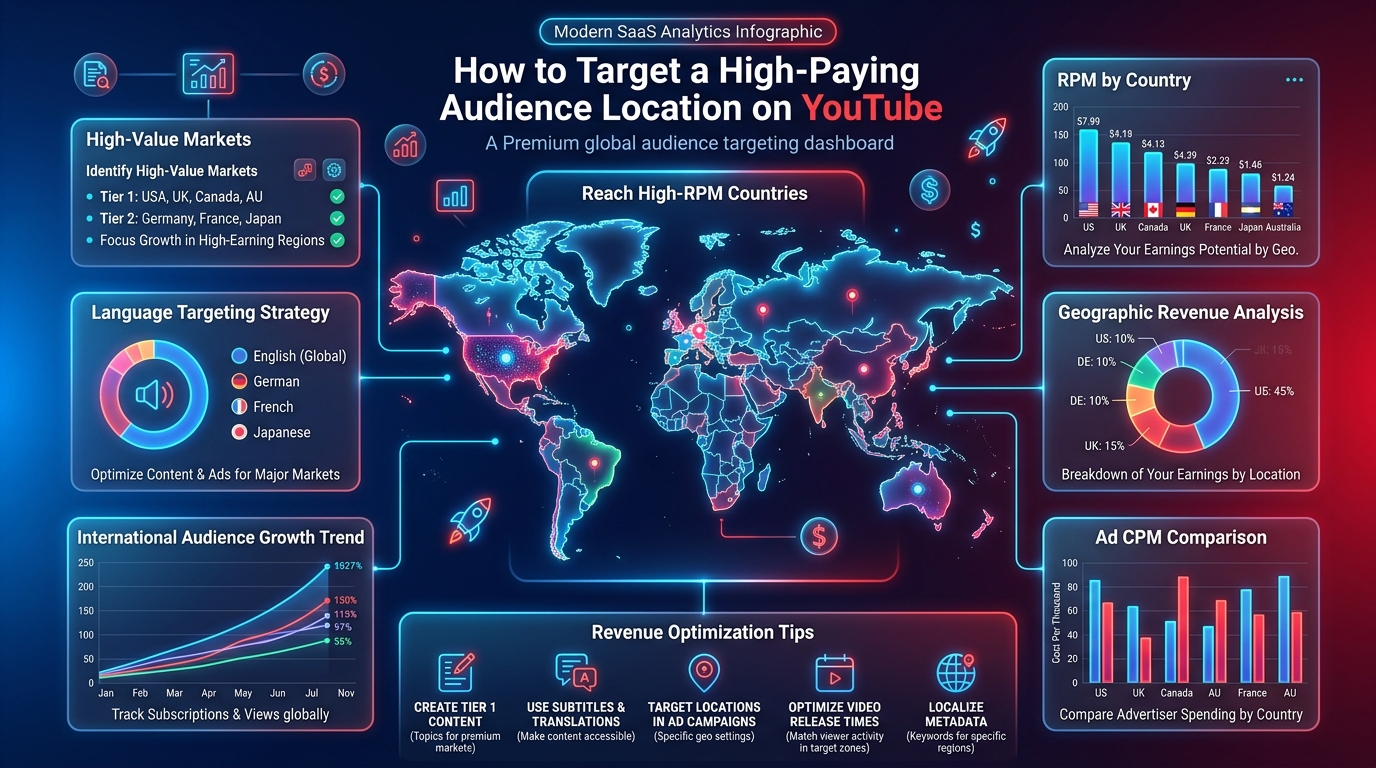
As we have established in our previous breakdowns of global RPM economics, the geographic location of your viewers is the single biggest factor dictating your AdSense payout. A viewer in the United States is mathematically worth up to 20 times more than a viewer in a developing nation.
The theory is simple, but the execution is difficult. If you live outside of North America or Western Europe, how do you convince the YouTube algorithm to push your videos to a high-paying Tier 1 audience? How do you effectively change your audience location?
Here is the strategic blueprint for localizing your content, penetrating high-RPM markets, and the dangerous myths you must avoid along the way.
The Myth of the VPN
Let's debunk the most pervasive myth immediately: Uploading your videos using a VPN routed through the United States will NOT give you an American audience.
YouTube's algorithm does not care where your IP address is located when you press the "Upload" button. It cares exclusively about viewer behavior. If you use a US VPN, but your video title is in Spanish, and the video is spoken in Spanish, the algorithm will quickly test it on Spanish-speaking viewers. The location data of the upload origin is entirely irrelevant to audience targeting.
Do not waste money on a VPN hoping it will trick the system. It won't.
Strategy 1: The Multi-Language Audio Revolution
The most powerful localization tool YouTube has introduced in the last decade is the Multi-Language Audio feature. This allows you to upload multiple dubbed audio tracks to a single video.
If you create incredible content in your native language (e.g., Hindi), you can hire a voice actor on Fiverr or use high-end AI voice cloning software (like ElevenLabs) to create a perfect English dub. You upload that English audio track to the same video. When an American viewer clicks on your video, YouTube automatically plays the English track based on their browser settings.
- The Result: You keep your existing domestic audience, but algorithmically open the door to the massive, high-paying English-speaking market without needing to manage two separate channels.
Calculate the Localization ROI
Is paying $50 for an English dub worth it? Open the YouTube Earnings Calculator. Input your expected views, but use an American RPM (e.g., $10.00). If the projected revenue far exceeds the $50 cost of the dubbing, localization is a profitable business move.
Strategy 2: Metadata Localization
If you cannot afford full audio dubbing, the next best strategy is metadata localization. YouTube allows you to translate your Video Title and Description into multiple languages.
If your video relies heavily on visuals (e.g., a silent woodworking tutorial, a 4K drone tour, or a relaxing cooking video), you do not need English audio. You simply need English search terms.
By translating your titles into English, German, and French, your visual-only video will begin appearing in search results across high-paying Tier 1 nations. Ensure you also add accurate, timed closed captions (CC) in those languages to increase retention.
Strategy 3: Cultural Targeting and Aesthetics
If you are actively producing English content from outside the US or UK, you must ensure your content matches the cultural expectations and aesthetics of that audience.
Pacing and Editing: Western audiences, particularly in the US, expect incredibly fast-paced editing, sharp hooks within the first 5 seconds, and high-contrast thumbnails. If your editing style is slow and highly localized to your home country's broadcasting style, the US audience will click away immediately. This destroys your retention, signaling to the algorithm to stop showing your video in the US.
Cultural References: If you are making a finance video targeting Americans, use dollars, not your local currency. Use American tax examples (like a 401k or IRA) rather than your local equivalents. You must make the viewer feel like the content was tailor-made for them.
The Keyword Targeting Strategy
Search-based content is the easiest way to penetrate a foreign market. You must research what your target demographic is searching for.
Use tools like Google Trends and filter specifically for the "United States" or "United Kingdom". Find out what specific problems those demographics are trying to solve right now. If you create a highly optimized tutorial solving a problem specific to US business owners, the algorithm has no choice but to serve your video to US viewers, regardless of where you live.
| Targeting Method | Effort Level | Effectiveness for Tier 1 Penetration |
|---|---|---|
| Using a VPN to upload | Low | 0% (Does not work) |
| Translating Titles/Tags | Low | High (For visual/silent content only) |
| English Closed Captions | Medium | Moderate (Many viewers dislike reading subtitles) |
| Multi-Language Audio Dubbing | High | Extremely High (Creates a native viewing experience) |
| Native English Voiceover/Host | High | Maximum (Complete cultural alignment) |
Frequently Asked Questions
If I change my channel country in the settings, will it target that country?
No. The channel location setting is purely for display purposes on your "About" page and determines your eligibility for the YouTube Partner Program. It has absolutely zero effect on algorithmic audience targeting.
Should I start a second channel for my English content?
If your content relies heavily on a on-camera personality speaking your native language, starting a second "English only" channel (using an AI voiceover or a hired host) is often safer than trying to force subtitles onto an audience that refuses to read them.
Does YouTube penalize AI voiceovers?
YouTube penalizes *low-quality, spammy* robotic voices. If you use high-end, emotive AI cloning (which sounds indistinguishable from a human) and pair it with highly original, valuable visual content, you will not be penalized and can easily monetize the channel.
Can I target high-paying countries with Shorts?
Yes, the same localization rules apply to Shorts. However, remember that Shorts rely on a pooled revenue model, so even if you capture a US audience, the RPM will still be vastly lower than a long-form video.
Conclusion
You are not geographically locked into a low RPM. The beauty of YouTube is that you can build a digital export business from anywhere in the world.
By treating localization as a serious marketing strategy—utilizing proper English metadata, adopting Western pacing, and leveraging multi-language audio tracks—you can successfully hijack the YouTube algorithm and force it to serve your content to the highest-paying audiences on the planet.