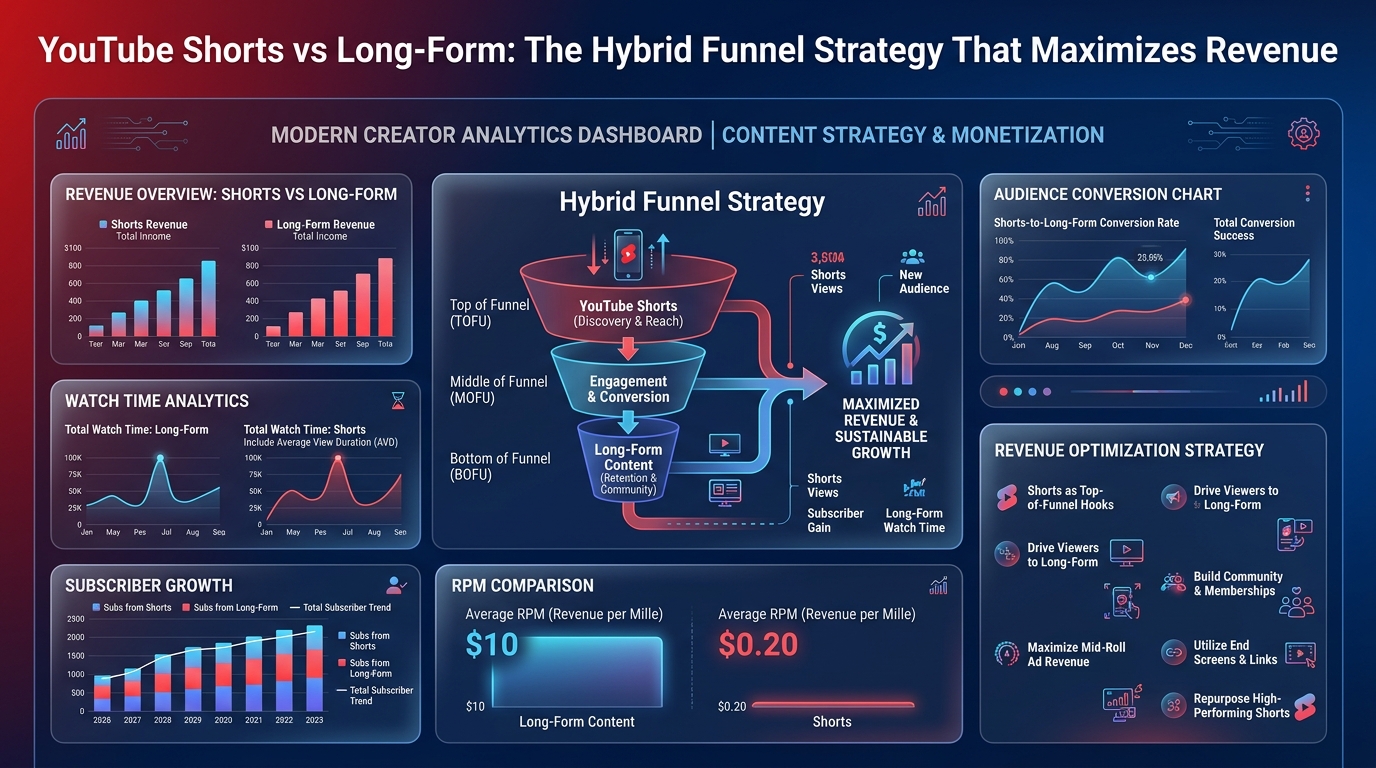
The YouTube Shorts vs long-form debate has split the creator community in two. One camp insists Shorts are the future and points to the billions of daily views the format generates. The other camp dismisses Shorts as a revenue black hole and clings to traditional long-form content for its superior RPM.
Both camps are half-right — and both are leaving money on the table. The most sophisticated YouTube growth strategy in 2026 is not a choice between Shorts and long-form. It is a deliberate hybrid funnel that uses Shorts as a high-reach subscriber acquisition engine and long-form as the monetization engine.
🔧 Recommended ChafikTech Tool
Why it matters for the hybrid strategy: Use our calculator to separately project your Shorts revenue and your long-form revenue. The dramatic difference in RPM between the two formats makes it clear why the funnel strategy is financially superior to relying on Shorts alone — and shows you the exact dollar value of each long-form subscriber your Shorts convert.
Understanding the Revenue Gap
Before building the funnel strategy, you need to understand the fundamental economics of why these formats pay differently:
| Metric | YouTube Shorts | Long-Form Videos |
|---|---|---|
| Typical RPM | $0.03–$0.07 | $2–$25+ |
| Ad formats available | Only between-video ads | Pre-roll, mid-roll, display, overlay |
| Average watch time | 15–60 seconds | 5–20+ minutes |
| Ad impressions per view | ~0.05 (shared pool) | 2–5 per video |
| Subscriber conversion rate | High (viral reach) | Lower (less discovery) |
| Audience retention quality | Low (passive swipers) | High (active seekers) |
The 5-Step Hybrid Funnel Strategy
Create Shorts That Tease Long-Form Content
Every Short you publish should function as a trailer or cliffhanger for a long-form video. The Short answers a micro-question but creates curiosity about the full answer. Example: a Short titled "The #1 mistake YouTubers make with thumbnails" (30 seconds) that ends with "I made a full breakdown video — it's on my channel."
Pin a Long-Form Video in Your Shorts Comments
YouTube allows you to pin a comment on your Short. Always pin a comment with a clear call to action: "Want the full strategy? Watch my 15-minute breakdown: [video title]." A pinned comment with a direct recommendation dramatically outperforms hoping the algorithm surfaces your long-form to Short viewers.
Upload Shorts in Bursts to Accelerate Subscriber Growth
Shorts are algorithmically distributed to non-subscribers. Long-form videos are primarily shown to existing subscribers. This means Shorts are your external marketing channel — they reach people who have never heard of you. Publishing 3–5 Shorts per week in bursts creates a compounding discovery effect that grows your subscriber base faster than any other organic strategy.
Anchor Long-Form Revenue With Consistent Uploads
While Shorts grow your audience, your long-form catalog is your revenue foundation. Even on weeks when you publish no Shorts, your long-form library earns AdSense revenue from search traffic and suggested video placements. Aim for 1–2 long-form videos per week minimum to maintain algorithmic favor and revenue consistency.
Measure Subscriber Conversion Rate, Not Views
The metric that validates your hybrid funnel is your Shorts' subscriber conversion rate. In YouTube Studio → Content → Shorts, look for the "Subscribers gained" metric. A healthy Short converts 0.5%–2% of viewers into subscribers. If your conversion rate falls below 0.2%, your Short is attracting the wrong audience for your long-form niche.
Niche-Specific Funnel Strategies
The hybrid funnel works differently across niches:
- Finance / Investing: Short reveals a shocking statistic ("The average 30-year-old has $X in savings"). Long-form explains the full solution. High subscriber conversion because the audience seeks actionable advice.
- Technology / Reviews: Short shows a 30-second feature demo or "hot take." Long-form provides the full review with affiliate links. Shorts in tech generate above-average subscriber conversions because viewers want to trust a source before making purchase decisions.
- Gaming: Short clips of impressive gameplay moments. Long-form covers tutorials, tier lists, and game reviews. Gaming Shorts have the lowest subscriber conversion because viewers are primarily passive entertainment seekers.
- Education: Short answers one specific question in under 60 seconds. Long-form covers the full module. Education channels see the highest subscriber conversion rates (often 3%+) because subscribers actively want to learn more.
When the Hybrid Strategy Breaks
The hybrid funnel fails when your Shorts and long-form content cover fundamentally different topics. If your Shorts are trending sound clips or meme content but your long-form is serious educational content, the subscribers your Shorts generate will have no interest in your long-form — leading to low watch time, poor retention, and algorithm suppression of your long-form videos.
Frequently Asked Questions
Conclusion
The choice between Shorts and long-form is a false dilemma. Shorts are your discovery engine; long-form is your revenue engine. The creators who understand this distinction and deliberately connect the two formats with a proper funnel strategy are building YouTube businesses that are both fast-growing and financially sustainable.
Use our YouTube Earnings Calculator to quantify the revenue gap between your Shorts and long-form content. That gap is the financial argument for building the funnel today.