Table of Contents
It is the most common misconception on the internet: "A million views equals a million views."
If you put two creators in a room—both celebrating exactly one million channel views this month—one might be struggling to pay their rent, while the other is shopping for a luxury car. This massive earning discrepancy frustrates new creators who rely on outdated "pay-per-view" myths.
YouTube does not pay you for views. It pays you a percentage of the ad revenue generated during those views. Because every audience is completely different, the value of their attention varies wildly. Let’s break down the hidden metrics that dictate why the exact same view count can result in radically different paychecks.
The Niche Multiplier: Who Are You Talking To?
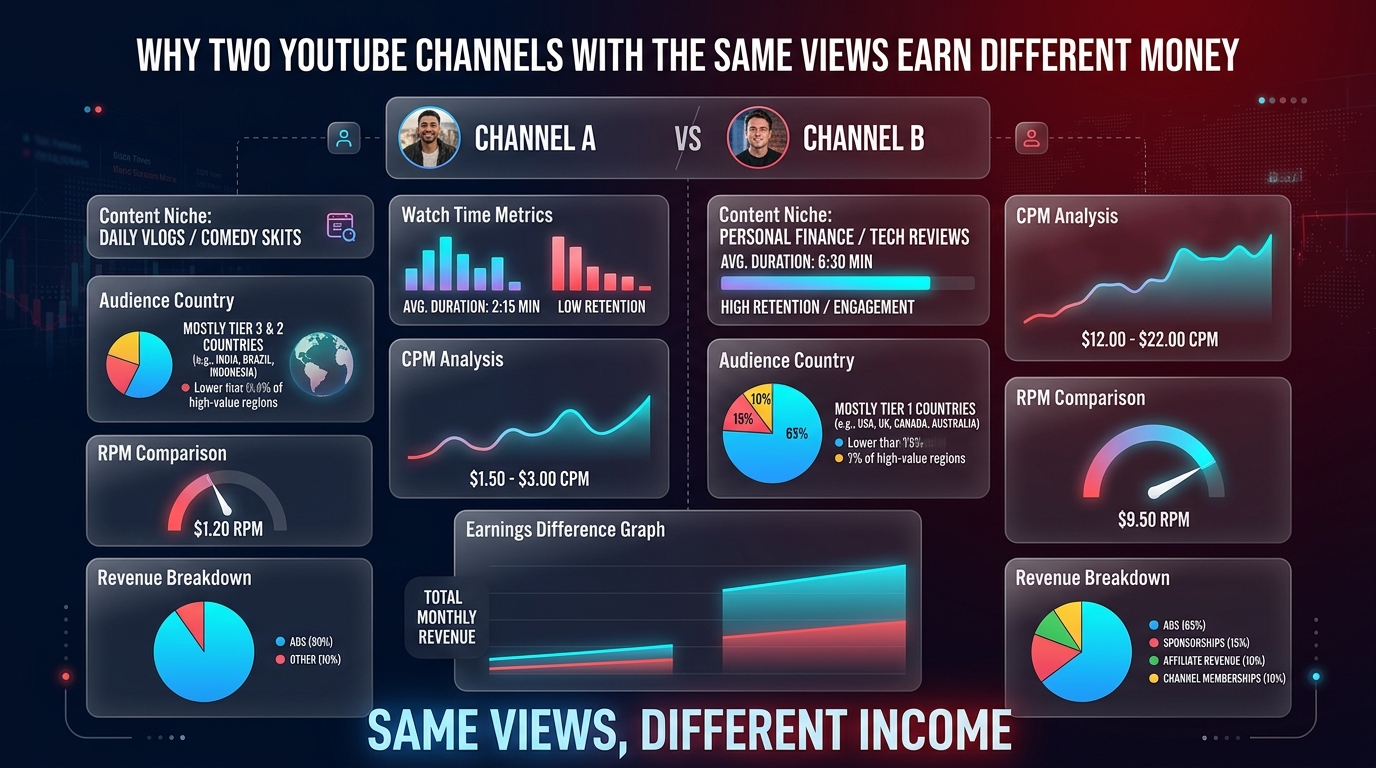
The single most powerful factor creating an earnings gap is the channel's niche. This comes down to simple advertiser intent.
Imagine Channel A makes prank videos aimed at teenagers. A teenager watching a prank video is generally not looking to spend money. Advertisers bidding on these videos are usually promoting low-cost mobile games or fast food. They bid pennies for the ad space.
Now imagine Channel B makes software tutorials for small business owners. A business owner watching a software tutorial is actively looking for a solution and possesses a corporate credit card. SaaS (Software as a Service) companies know that acquiring this customer is worth thousands of dollars. Therefore, they will aggressively bid $30, $40, or even $50 per thousand impressions just to get their ad in front of that specific viewer.
Same view count. Totally different financial outcome.
The Video Length and Mid-Roll Strategy
The duration of the video acts as a physical limit on how much money can be extracted from a single view.
If a video is under eight minutes long, YouTube only permits a pre-roll ad (before the video) and a post-roll ad (after the video). If a viewer clicks away halfway through, they only see one ad.
If a video crosses the eight-minute mark, the creator unlocks mid-roll advertisements. A highly engaging 20-minute video might naturally feature three or four mid-roll ads. Thus, one single view on the 20-minute video could generate four times the ad revenue of a single view on a 4-minute video.
A creator who strictly produces long-form, highly engaging essays will always mathematically out-earn a creator producing 3-minute skits, even if their total view counts are identical.
Audit Your Channel's Performance
Are your videos long enough, but your revenue is still lagging behind your peers? You might have an optimization issue. Use our AdSense Audit Tool to compare your current earnings against industry benchmarks and find out where you are losing money.
The Geographic Demographic (Tiered Advertising)
As we explored in our deep dive on viewer geography, the physical location of the person watching the video drastically alters the payout.
Advertisers in countries with high purchasing power (like the US, UK, and Australia) have massive marketing budgets. Advertisers in developing nations have much smaller budgets.
- Channel A receives 100,000 views strictly from India. (Estimated payout: $30 - $80)
- Channel B receives 100,000 views strictly from the United States. (Estimated payout: $800 - $1,500)
The language you speak, the topics you cover, and the cultural references you make will naturally filter your audience into different geographic tiers, fundamentally altering your baseline pay.
| Factor | Low-Earning Channel Profile | High-Earning Channel Profile |
|---|---|---|
| Niche | Pranks, Memes, General Gaming | Finance, SaaS, Real Estate, Tech |
| Audience Age | Under 18 (Low disposable income) | 25 to 45 (High disposable income) |
| Video Length | Under 5 minutes (Pre-roll only) | 12+ minutes (Optimized Mid-rolls) |
| Geography | Emerging Markets (Tier 3) | US, UK, Scandinavia (Tier 1) |
The "Hidden" Revenue: Premium Views and Super Chats
AdSense is only one part of the equation. Your total RPM (Revenue Per Mille) includes alternative monetization features built directly into the platform.
If Channel A has a highly engaged, loyal community, they might receive hundreds of dollars in Super Chats during a livestream, or have thousands of paying Channel Members. Furthermore, if a large percentage of their audience subscribes to YouTube Premium (which removes ads but pays creators based on watch time), their revenue stabilizes significantly.
Channel B might rely on viral search traffic. People click the video, watch the ad, get their answer, and leave. They don't buy memberships, they don't leave Super Thanks, and they don't subscribe to Premium. Channel B is relying 100% on programmatic ads.
The Ad-Blocker Penalty
A view only generates ad revenue if an ad is actually served. If a massive portion of a creator's audience is technically literate (for example, a Linux programming channel) it is highly likely that 40% to 60% of their viewers are utilizing ad-blockers.
These views count toward the total view metric, making the channel look incredibly popular, but they contribute $0 to the creator's bank account.
Simulate the Differences
Stop guessing how much a niche change will affect your income. Use our interactive YouTube Earnings Calculator. Input the same view count, but switch the niche from "Gaming" to "Finance" to see the staggering difference in potential earnings.
Same Views, Completely Different Earnings
| Channel Type | Monthly Views | Avg. RPM | Monthly AdSense Revenue |
|---|---|---|---|
| Gaming Commentary (US, ages 13–17) | 1,000,000 | $1.20 | $1,200 |
| Comedy Skits (Global, mixed age) | 1,000,000 | $2.50 | $2,500 |
| Personal Finance (US, ages 25–45) | 1,000,000 | $9.00 | $9,000 |
| B2B Software Tutorials (US, professionals) | 1,000,000 | $14.00 | $14,000 |
Common Mistakes
- Comparing Your RPM to a Creator in a Different Niche: A gaming channel comparing its $1.50 RPM to a finance channel's $9.00 RPM is a meaningless comparison. The only relevant benchmark is your own historical trend and your niche average.
- Assuming Viral = High Revenue: A video that goes viral often attracts viewers who are not in your core audience. These curiosity-based viewers have low watch time and come from random global locations — leading to a paradoxically low RPM on your highest-viewed video.
Best Practices
- Niche Into a High-Value Subsection: Instead of "cooking videos," create "meal prep for busy professionals" — this attracts an older, higher-income demographic that commands significantly better ad rates.
- Use YouTube Analytics Demographics: Check the Age and Gender report monthly. If your audience is skewing younger or more international, adjust your content strategy to attract the demographics that advertisers pay most for.
💡 Model Your True Earnings Potential
Your current RPM is not fixed — it changes as your niche and audience evolve. Use the YouTube Earnings Calculator to model what your channel could earn at a $5, $8, or $12 RPM with your current view count.
Frequently Asked Questions
Do subscribers affect how much you get paid?
No. AdSense only pays based on ad impressions, not your subscriber count. A channel with 10,000 subscribers can easily out-earn a channel with 1 million subscribers if they are getting more views in a higher-paying niche.
Why do my earnings fluctuate even when my daily views stay exactly the same?
Because advertiser budgets are dynamic. On weekends, ad spending often drops. During the end of a fiscal quarter (March, June, September, December), companies dump their remaining marketing budgets, causing earnings to spike dramatically even if view counts remain flat.
Does a longer video guarantee more money?
Only if the viewer actually watches it. If you stretch a 3-minute video to 10 minutes, the viewer will get bored and click away before the mid-roll ad ever plays. High audience retention is required to make long-form videos profitable.
Is there a way to see what my specific audience is worth?
Yes. Go into your YouTube Studio, click on Analytics, and go to the Revenue tab. Your "RPM" metric is the exact dollar amount your specific audience generates per 1,000 views, factoring in all these variables.
Can I change my niche without starting a new channel?
Yes, but it is a slow process. If you pivot from gaming to tech reviews, your current audience will likely skip the new videos, hurting your click-through rate. However, over several months, the algorithm will find a new, higher-paying audience for you.
Conclusion
View counts are a vanity metric. They look great on a thumbnail and they earn you Play Buttons, but they do not deposit cash into your bank account.
The creators making life-changing money on YouTube aren't necessarily the ones with the most views; they are the ones who understand how to attract a valuable demographic, keep them engaged through strategic ad placements, and foster a community willing to support them directly. Once you stop chasing empty views and start chasing valuable attention, your channel transforms from a hobby into a business.