Table of Contents
Every January, panic sweeps through publisher forums and Facebook groups. "My AdSense earnings dropped 40% overnight! Is my site penalized?"
The publisher frantically checks their Google Analytics, only to find that their traffic hasn't changed at all. They still had 5,000 visitors yesterday, just like they did in December. So why did their revenue get cut in half?
The answer has nothing to do with Google's algorithm, SEO, or the quality of your content. It has everything to do with corporate America. AdSense operates on an auction system, and that auction is entirely controlled by Advertiser Budget Cycles. In this guide, we break down exactly how these cycles work, why your earnings fluctuate so wildly, and how to protect your publishing business from the inevitable seasonal drops.
Recommended ChafikTech Tool
Why you need it: To survive the seasonal drops, you must build a 12-month revenue forecast.
How it works: You can input your average RPM, and manually adjust the "Fill Rate" or RPM value downward by 40% to simulate a Q1 slump. This allows you to mathematically predict your lowest-earning months and ensure your business has enough cash flow to survive.
The Four Quarters of Ad Revenue
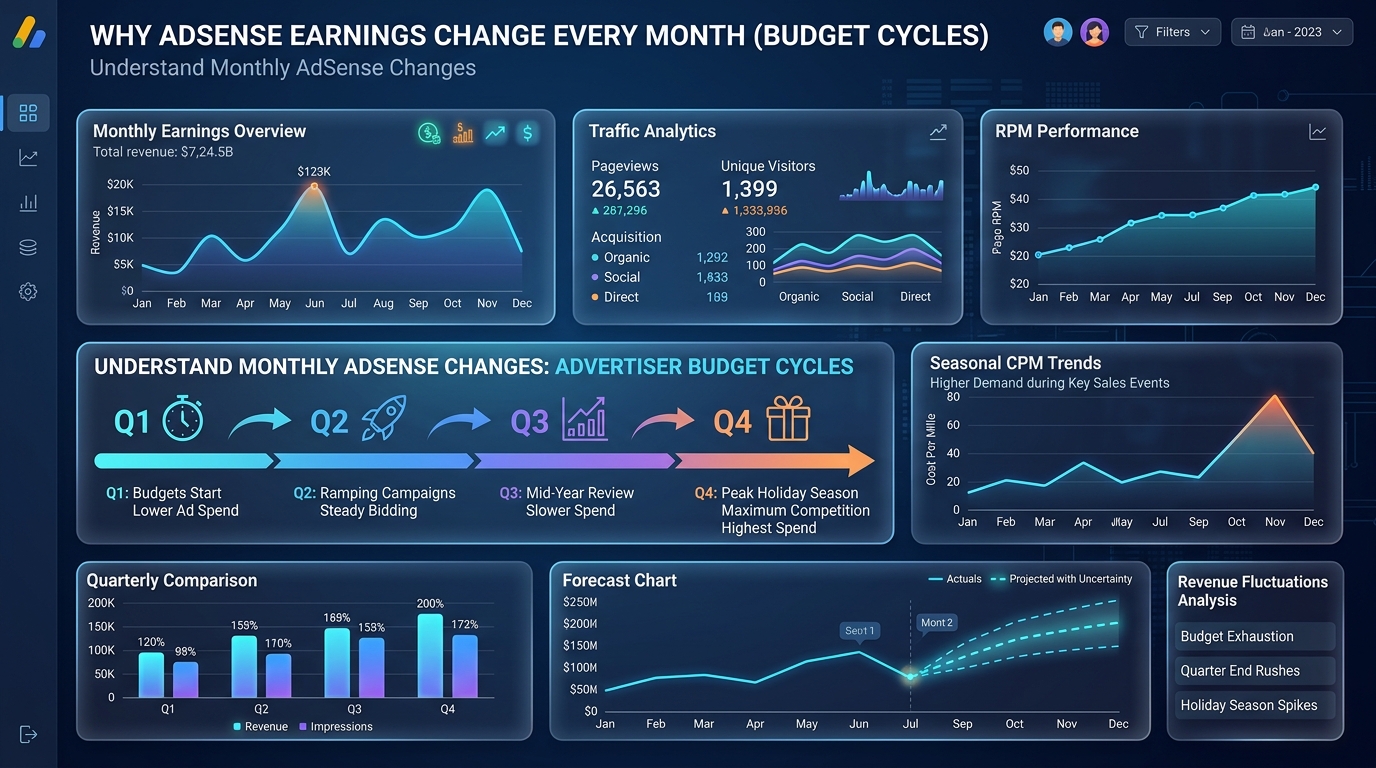
Corporate marketing departments do not spend money evenly throughout the year. They are given quarterly budgets, and their spending habits dictate the bids in the AdSense auction. Here is the exact cycle your website experiences every single year:
Q1 (January 1 – March 31): The Slump
What happens: On January 1st, RPMs universally crash across almost all niches. Expect a 30% to 50% drop compared to December.
Why it happens: Advertisers exhausted their budgets during the holiday rush. In January, corporate teams are still finalizing their new annual budgets and holding off on ad spending. Furthermore, consumers are "shopped out" and paying off credit card bills, making them less valuable targets for e-commerce ads.
Q2 (April 1 – June 30): The Stabilization
What happens: RPMs begin to climb steadily back to your niche's "normal" baseline.
Why it happens: Q1 budgets have been approved and deployed. Advertisers start running spring campaigns (travel, home improvement, tax software). By the end of June, you will often see a mini-spike in RPM as marketing managers rush to spend any leftover Q2 budget before the quarter closes (a phenomenon known as the "end-of-quarter push").
Q3 (July 1 – September 30): The Plateau
What happens: Traffic often dips in August, but RPMs generally remain stable and healthy.
Why it happens: Summer vacations mean fewer people are glued to their computer screens (lowering your total pageviews), but advertiser spending remains consistent. In September, Back-to-School campaigns inject fresh capital into the auction, providing another end-of-quarter RPM boost.
Q4 (October 1 – December 31): The Golden Quarter
What happens: RPMs skyrocket to their highest levels of the year, often 2x or 3x higher than Q1.
Why it happens: This is the holy grail of publishing. Retailers, software companies, and brands dump massive amounts of money into the ad auction to capture Black Friday, Cyber Monday, and Christmas shoppers. The competition for ad space is so fierce that advertisers are forced to bid exorbitant amounts. The RPM peak usually occurs between November 20th and December 15th.
How to Buffer Against the Q1 Drop
You cannot change corporate advertising budgets, but you can change how your business operates. Professional publishers use the following strategies to survive the Q1 slump:
1. Cash Flow Management
Never treat your December AdSense payout as your "new normal." If you make $10,000 in December, expect to make $5,000 in January. Bank the excess Q4 revenue into a corporate savings account to cover your operating expenses (writers, hosting, software) during the lean months of Q1 and Q2.
2. Diversify with Affiliate Marketing
While display ad RPMs drop in January, certain affiliate niches absolutely explode. If your site covers health, fitness, finance, or organization, January is the "New Year, New Me" season. Your display ad revenue might drop 40%, but your Amazon or ClickBank affiliate commissions could triple, perfectly balancing your income.
3. Negotiate Direct Sponsorships
The programmatic ad auction is volatile. Direct sponsorships are stable. Use your site's metrics to sell fixed-price sidebar banners or sponsored posts directly to brands. If a brand signs a 6-month contract at $500/month, you get paid $500 in January regardless of what the AdSense auction does.
Seasonal AdSense RPM Multiplier (vs January Baseline)
| Month / Period | Relative RPM Multiplier | Primary Driver |
|---|---|---|
| January (Baseline) | 1.0x (e.g. $10 RPM) | Post-holiday advertiser budget reset |
| February – March | 1.1x – 1.2x | Valentine's Day, Spring promotions ramp up |
| August – September | 1.3x – 1.5x | Back-to-school campaigns |
| October – November | 1.6x – 2.2x | Black Friday, Q4 budget flush |
| December | 1.8x – 2.5x | Christmas shopping surge — peak of the year |
Common Mistakes
- Panicking in January: Every year, thousands of publishers think their site is broken or penalised when their January RPM drops 40–50% from December. This is completely normal and predictable. Do not make rash decisions based on January data.
- Not Publishing in Q3: The articles you publish in August and September will be indexed and ranking just in time for the Q4 RPM surge. Creators who slow down in summer miss the biggest monetisation window of the year.
Best Practices
- Plan Content Around Seasonal Peaks: Write gift guides, product comparison articles, and "best of" lists in October so they have 6–8 weeks to rank before the Black Friday and Christmas traffic surge.
- Budget Using Annualised Revenue: Instead of panicking at monthly fluctuations, calculate your trailing 12-month average RPM. This gives a much more stable number for financial planning.
📅 Model Your Q4 Revenue Potential
If your October RPM is typically 1.8x your January baseline, how much should you expect to earn this Q4? Use the Website AdSense Calculator to run the projection now.
Frequently Asked Questions
Conclusion
As a website publisher, you are not just a writer; you are a participant in the global advertising economy. Your income is directly tethered to the fiscal calendars of the world's largest corporations.
Stop panicking when January 1st arrives. Expect the Q1 slump, celebrate the Q4 spike, and use an earnings calculator to forecast your revenue across all 12 months. When you understand the cycle, you can build a resilient, predictable publishing business that thrives year-round.