Table of Contents
When two websites publish equally well-written articles on the same keyword, how does Google decide which one ranks on page one and which one gets buried on page five? The deciding factor is almost always website authority — a measure of how much trust and credibility Google (and third-party SEO tools) attribute to a domain based on its backlink profile.
For new website owners, authority is the most frustrating part of SEO because it cannot be bought, faked, or rushed. But understanding how it works — and how it directly impacts your ad revenue — helps you invest your time in the right activities from day one.
🔧 Recommended ChafikTech Tool
Higher authority websites rank for more competitive keywords and attract higher-quality traffic. This directly increases the CPM and RPM that advertisers are willing to pay. Use our calculator to model how doubling your monthly traffic — the natural result of growing your authority — would impact your monthly AdSense revenue.
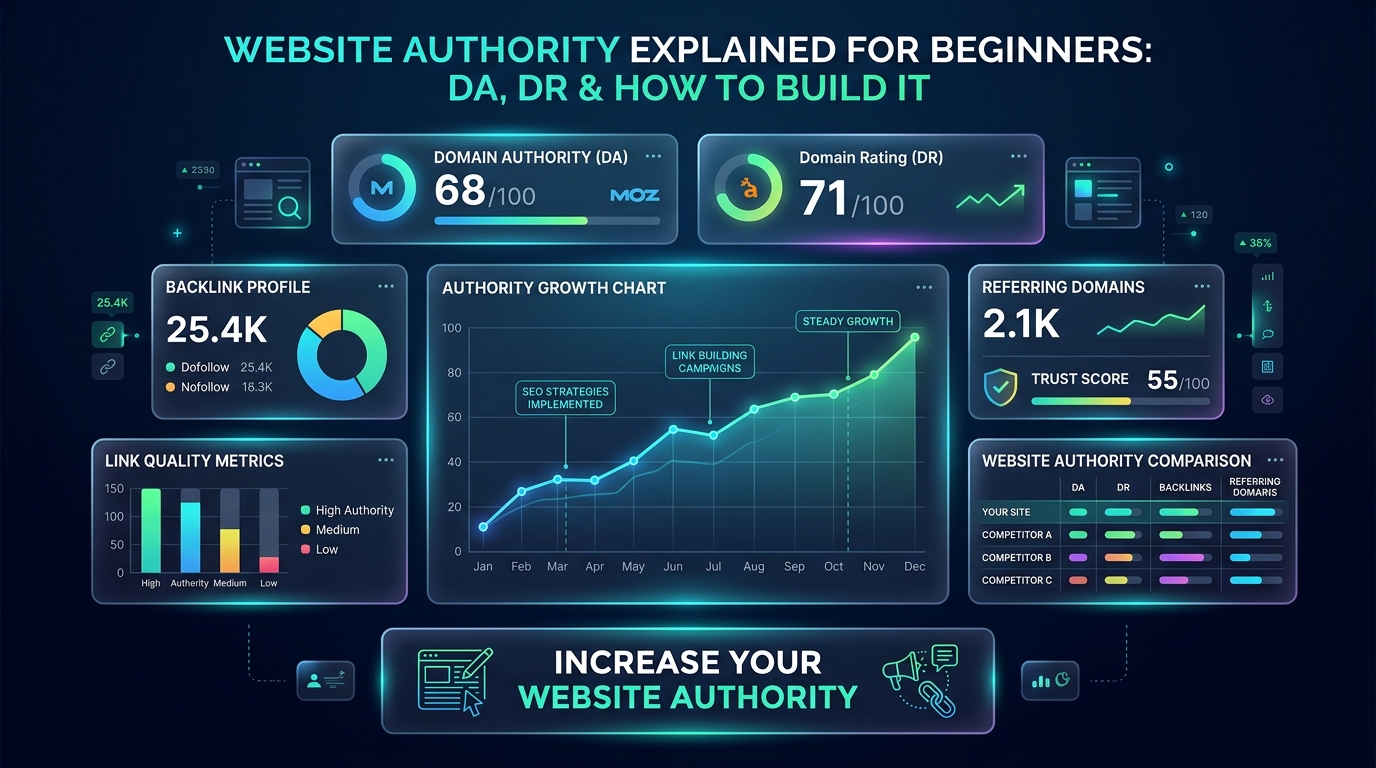
Domain Authority vs. Domain Rating: What's the Difference?
These two terms are frequently confused. Neither is published by Google — they are estimates created by SEO tool companies using their own proprietary data.
| Metric | Created By | Scale | What It Measures |
|---|---|---|---|
| Domain Authority (DA) | Moz | 1–100 | Likelihood of ranking based on backlink profile |
| Domain Rating (DR) | Ahrefs | 0–100 | Strength of backlink profile relative to all other websites |
| Authority Score | SEMrush | 0–100 | Combines backlinks, organic traffic, and spam signals |
Google's actual internal authority metric is called PageRank, but it has not been publicly updated since 2016. All third-party scores are approximations. The key insight: they all measure the same underlying thing — the quality and quantity of websites linking to yours.
Why Authority Matters for Ad Revenue
Beyond rankings, website authority has a direct financial impact on publishers:
- Higher-paying advertisers target authoritative sites. Premium display networks (like AdThrive/Mediavine or direct programmatic deals) require minimum DA/DR thresholds before accepting publishers. Reaching DA 30+ unlocks access to much better ad networks than basic AdSense.
- Authoritative sites rank for high-CPC keywords. Competitive keywords in finance, insurance, and tech niches pay $5–$50+ per click. These keywords are dominated by high-DA sites. Building authority opens these keywords to you.
- Advertisers pay higher CPMs for trusted environments. Brand safety is critical for large advertisers. They configure their campaigns to bid higher on placements within high-DA websites because they trust those environments.
How Website Authority Is Built
1. Earning Backlinks (The Primary Driver)
Every time a credible, relevant website links to your content, it passes a fraction of its authority to you. A single backlink from a news site with DA 80 can have more impact than 100 links from low-DA blog directories. Quality far outweighs quantity.
Effective link-earning strategies:
- Create "linkable assets": Original research, unique data studies, or comprehensive guides that other writers want to cite as sources.
- Guest posting: Write expert articles for publications in your niche in exchange for an author bio link.
- HARO / Connectively: Respond to journalist queries as an expert source. Getting quoted in media publications earns high-authority backlinks.
- Broken link building: Find dead links on relevant websites and offer your content as a replacement.
2. Content Topical Authority
Google increasingly rewards sites that demonstrate deep, comprehensive expertise in a specific topic area — sometimes called "topical authority." A site with 50 in-depth articles all covering the topic of website monetization will outrank a site with 500 scattered articles on unrelated topics, even if the second site has more backlinks.
3. Age and Trust Signals
Older domains with consistent publishing history accumulate trust over time. This is not something you can accelerate, but maintaining publishing consistency compounds your authority gains.
Backlink Quality Comparison
| Backlink Source | Impact on Authority | Risk Level (Google Penalties) |
|---|---|---|
| Major News Publication (Forbes, NYT) | Extremely High | Zero (Highly trusted) |
| Niche-Relevant Blog (Guest Post) | High | Low (If context is natural) |
| Web 2.0 Profiles (Medium, Blogger) | Negligible (Mostly nofollow) | Low |
| Fiverr "5,000 Backlinks" Package | Negative (Spam) | Fatal (Manual Action risk) |
Common Mistakes
- Treating DA as a Google Metric: Domain Authority (DA) is a metric invented by Moz, and Domain Rating (DR) is from Ahrefs. Google does not use either of them. They are third-party estimations of your backlink profile.
- Ignoring Relevance: Getting a backlink from a high-DA cooking blog to your personal finance website passes very little value because the topics are completely unrelated.
Best Practices
- Digital PR: The safest and most powerful way to build authority is by publishing unique statistics or surveys in your niche, then emailing journalists offering the data as a source.
- Internal Linking: You can pass the "link juice" from a highly-linked page (like your homepage) to a brand new article using strategic internal links.
🚀 Estimate Future Traffic
As your website authority grows, you will naturally rank for higher-volume keywords. Estimate how much your revenue will increase if your traffic doubles using the Website AdSense Calculator.
Frequently Asked Questions
Conclusion
Website authority is the long game of SEO. You cannot shortcut it, but you can accelerate it with a clear strategy: publish exceptional, linkable content consistently, actively pursue high-quality backlinks in your niche, and build deep topical coverage around your core subject. As your authority grows, so does your organic traffic and — critically — the RPM advertisers are willing to pay to reach your audience. Use our Website AdSense Calculator to project your earnings at different traffic milestones as you grow.