Table of Contents
If you build an audience of 100,000 monthly visitors, you should be able to quit your day job, right? It depends entirely on where those 100,000 visitors came from.
In the digital publishing world, traffic is not treated equally by advertisers. 10,000 visitors from Google Search will almost always generate more revenue than 50,000 visitors from Facebook or Pinterest. This is because programmatic advertising (like Google AdSense or Mediavine) does not just buy pageviews; it buys user intent.
In this head-to-head comparison, we will explore the psychology of search intent versus interruptive browsing, why social media traffic pays so little, and how to balance both to build a resilient, highly profitable website.
Recommended ChafikTech Tool
Why you need it: You need to understand how different traffic sources impact your bottom line.
How it works: Run two scenarios through the calculator. First, input your organic traffic with a high RPM ($15). Then, input your expected viral social media traffic with a low RPM ($3). You will quickly see why chasing social virality is often a poor financial strategy compared to steady SEO.
The Psychology of Intent vs Interruption
To understand why advertiser algorithms bid the way they do, you must understand what the user was doing exactly five seconds before they arrived on your website.
Organic Search (High Intent)
The user recognized they had a problem (e.g., "how to fix a leaky faucet"). They opened Google, typed their problem, evaluated the search results, and actively chose your article.
The Result: They are highly engaged. They will read the article slowly, scroll deeply, and most importantly, they are in a buying mindset. If an ad for plumbing tools appears, there is a high probability they will click it and make a purchase.
How the Ad Auction Responds
Advertisers track "Conversion Rates" religiously. They know that if they spend $1,000 showing ads to users who arrived via Google Search, they might get 50 sales. If they spend $1,000 showing ads to users who arrived via Pinterest, they might only get 2 sales.
Because social traffic converts so poorly, advertiser algorithms automatically slash their bids when they detect a user coming from a social network. This is why a website generating 100% of its traffic from Pinterest might struggle to break a $4 RPM, while the exact same website with 100% Google traffic easily clears a $20 RPM.
The Affiliate Marketing Divide
The revenue disparity between organic and social traffic becomes even more extreme when you factor in affiliate marketing (Amazon Associates, ClickBank, SaaS programs).
Organic search articles (e.g., "Best laptops for students 2026") are designed to capture users at the very bottom of the sales funnel. These users already have their credit cards out; they just need you to tell them which product to buy. Organic conversion rates often hover between 3% and 8%.
Social media traffic is top-of-funnel. You might get 10,000 clicks from a viral Facebook post about "Cool Tech Gadgets," but because the users were not actively shopping, your conversion rate might be 0.1%. Organic traffic wins the affiliate battle every single time.
Should You Abandon Social Media?
Absolutely not. While Organic Search provides the high-RPM financial foundation, it has one major weakness: Google Algorithm Updates.
If you rely on Google for 100% of your traffic, a single Core Update can destroy your business overnight. Social media traffic serves as a vital insurance policy. Professional publishers use a hybrid model:
- Organic Search pays the bills, funds the business, and generates the massive profits.
- Social Media acts as a safety net, builds brand awareness, and most importantly, acts as a funnel to capture email subscribers.
Revenue Impact: Organic vs Social Traffic
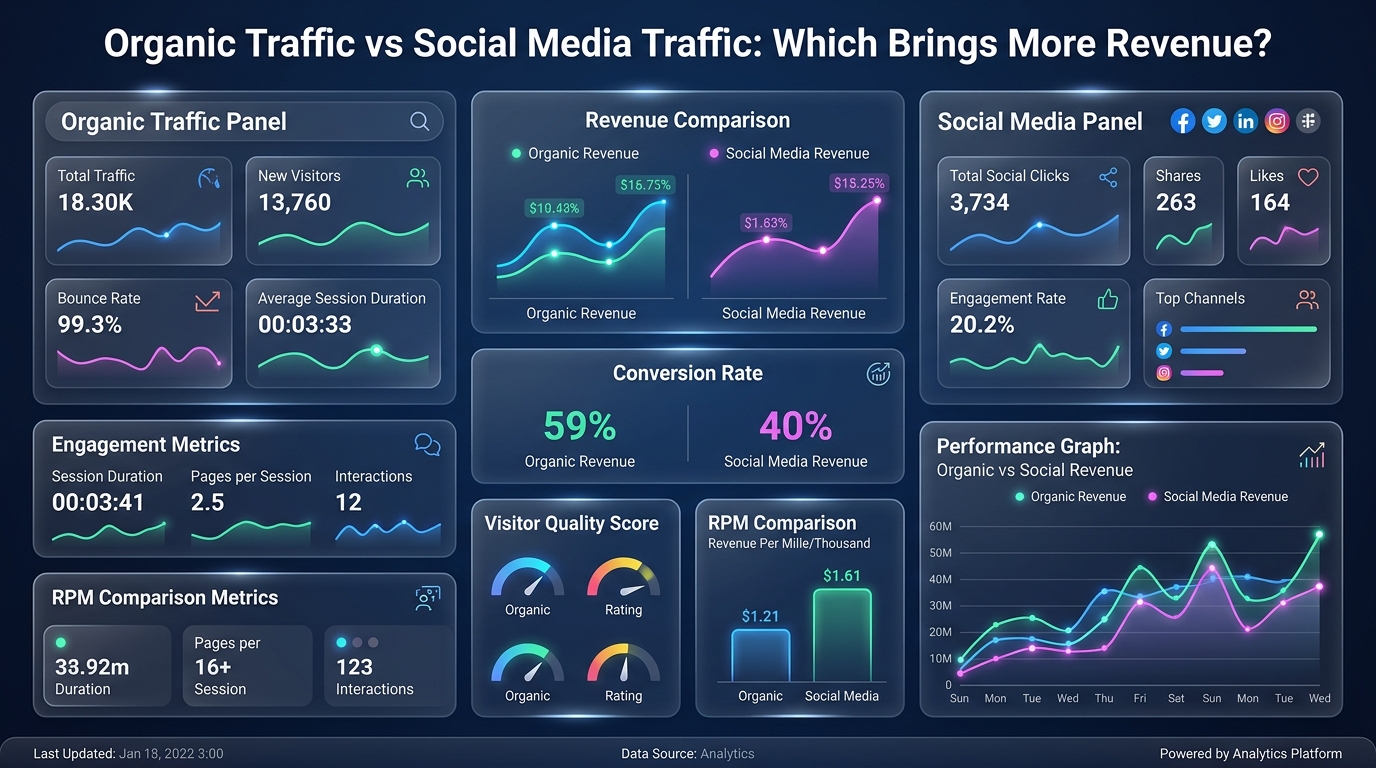
| Traffic Source | User Intent | Avg. Bounce Rate | Estimated AdSense RPM |
|---|---|---|---|
| Organic Search (Google) | High (Seeking solutions) | 40% - 60% | $15 - $35+ |
| Medium (Inspirational) | 65% - 75% | $8 - $15 | |
| Facebook / X (Twitter) | Low (Entertainment) | 80% - 90% | $2 - $6 |
| TikTok Link-in-Bio | Very Low (Curiosity) | 90%+ | $1 - $3 |
Common Mistakes
- Relying 100% on Social Traffic: Social media algorithms change daily. If your Facebook page reach drops, your website revenue drops to zero instantly. Organic search provides a much more stable baseline.
- Ignoring Bounce Rate: Traffic from TikTok or Instagram often clicks the link in your bio, looks at the page for 3 seconds, and immediately hits the back button. Advertisers will not pay a premium for users who don't stay on the page.
Best Practices
- Use Social Media as a Top-of-Funnel Source: Instead of sending social media traffic directly to an AdSense-monetized article, send them to an email opt-in page. You can then monetize that audience repeatedly via email newsletters.
- Write for Search, Promote on Social: Structure your articles to target low-competition SEO keywords first, then repurpose the key points into social media graphics to drive supplementary traffic.
💰 Calculate Your Blended RPM
If you get 50,000 visitors from Google and 50,000 from Facebook, your overall RPM will be a blended average. See how this affects your total income using the Website AdSense Calculator.
Frequently Asked Questions
Conclusion
Chasing viral social media traffic is a vanity metric trap. It feels great to see 10,000 real-time active users in Google Analytics, but if those users are bouncing after 10 seconds without clicking an ad or buying a product, you are just burning server bandwidth.
If your goal is to maximize your monthly revenue, 80% of your energy should be spent on SEO. Solve real problems for people actively searching for answers on Google. Search intent is the foundation of digital wealth.