Table of Contents
A publisher experiences a massive viral spike. Their traffic jumps from 5,000 to 50,000 visitors in a single day thanks to a feature on Google Discover. They open their AdSense dashboard the next morning expecting to see a 10x increase in revenue... only to find it barely doubled.
Why? Because 100,000 pageviews from Google Discover do not equal 100,000 pageviews from Google Search.
In programmatic advertising, the value of a visitor is dictated by their "intent." The source of your traffic tells the algorithm exactly how likely that user is to click an ad and buy a product. In this guide, we break down the major traffic sources, how they affect your RPM, and why diversifying your traffic is critical for revenue stability.
Recommended ChafikTech Tool
Why you need it: Traffic spikes from different sources will severely alter your blended RPM.
How it works: If you are planning an email newsletter blast or expecting a social media spike, you can use the calculator to model your revenue by inputting a lower RPM, allowing you to accurately forecast what that specific traffic spike is actually worth.
The Hierarchy of Traffic Sources
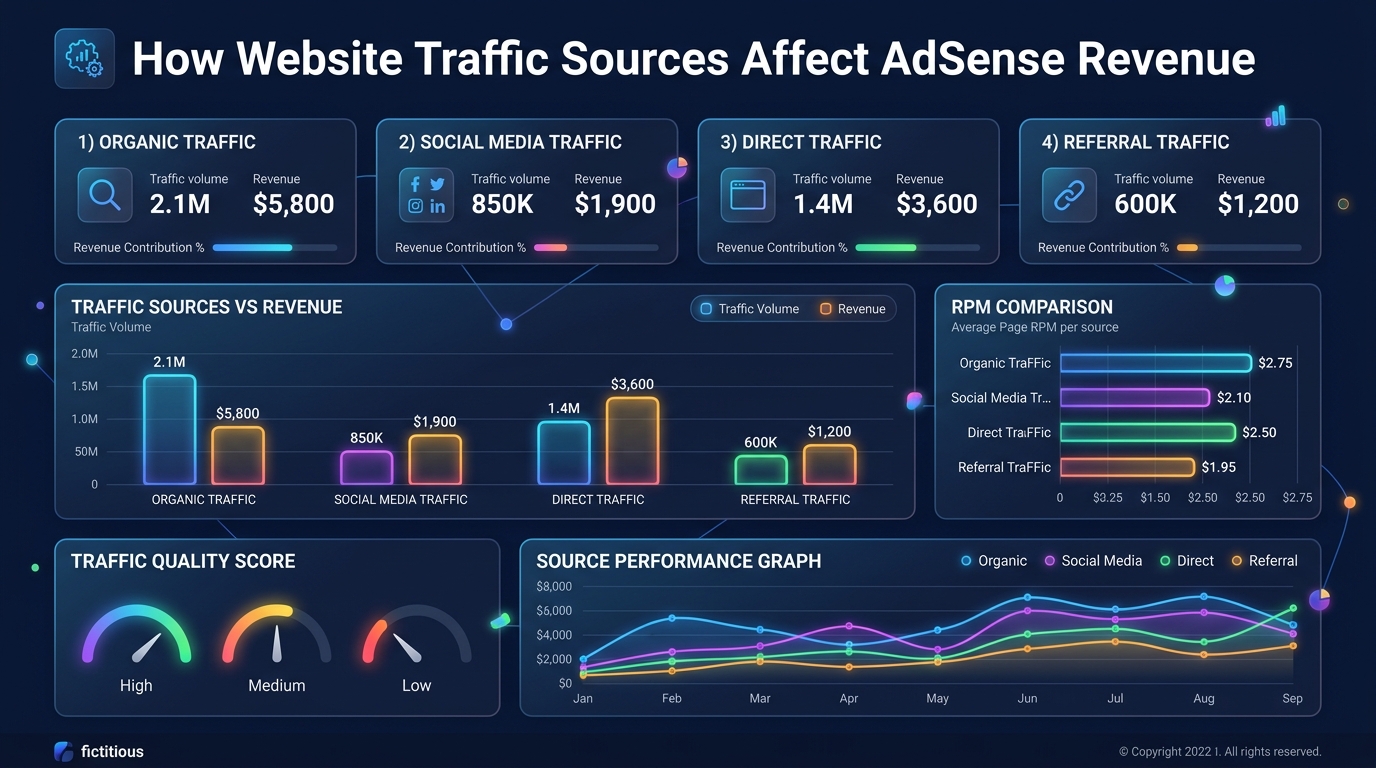
Advertisers bid in real-time for your ad slots. Their algorithms analyze the user's browser data, location, and crucially, how they arrived at your page. Here is how the different sources rank in terms of monetization power.
1. Organic Search (The Gold Standard)
Intent Level: Extremely High (Active Problem Solving)
RPM Impact: Highest Possible Baseline
When a user types "Best web hosting for WordPress" into Google and clicks your article, they have a specific problem they are trying to solve. They are in a buying mindset. Because they actively requested information, they are highly receptive to ads offering solutions to that exact problem. Advertisers know this, which is why Organic Search traffic commands the highest RPMs on the internet.
2. Direct & Newsletter Traffic
Intent Level: Medium to High (Brand Loyalty)
RPM Impact: Strong and Stable
These are users who typed your URL into their browser or clicked a link in your email newsletter. While they might not be actively looking to buy a product right this second, they trust your brand. They spend a long time on your site (high Session duration), scrolling deeply into your content. This high engagement leads to high ad Viewability, resulting in excellent Session RPMs.
3. Google Discover
Intent Level: Low (Passive Entertainment)
RPM Impact: 40% to 60% Lower than Search
Google Discover feeds articles to users based on their interests while they are scrolling on their phones. The user did not search for your article. They were passively browsing and your catchy headline interrupted them. While Discover can drive massive traffic volume, these users have short attention spans, bounce quickly, and rarely click ads. Expect your RPM to plummet during a Discover traffic spike.
4. Social Media (Facebook, Twitter, Pinterest)
Intent Level: Very Low (Interruptive Browsing)
RPM Impact: Lowest Possible Baseline
Social media traffic is notoriously difficult to monetize with display ads. Users on Facebook are there to see pictures of their friends, not to buy enterprise software. When they click your link, they are in a hurry to get back to their social feed. High bounce rates, low scroll depth, and low commercial intent mean social traffic often yields RPMs as low as $1 to $3, even in Tier 1 countries.
The Danger of "Blended RPM"
When you look at your AdSense dashboard, you see your Blended RPM — the average of all your traffic sources combined.
If you normally get 1,000 visitors a day from Google Search at a $20 RPM, your daily revenue is $20. If an article goes viral on Pinterest and brings in 9,000 visitors at a $2 RPM, your total revenue becomes $38 ($20 + $18) on 10,000 pageviews.
Your dashboard will now show a Blended RPM of $3.80. Many publishers panic, thinking they have been penalized or that their AdSense account is broken. In reality, their highly profitable Search traffic is simply being mathematically diluted by low-value social traffic.
How to Optimize for Different Traffic Sources
You shouldn't reject Discover or Social traffic just because the RPM is lower. Volume is still volume. Instead, you must optimize your site to handle it:
- For Organic Search: Focus on Affiliate Marketing. Users are ready to buy. Embed high-converting affiliate links high up in the article.
- For Google Discover: Focus on Ad Density. Discover users bounce fast. Make sure you have a highly viewable ad near the top of the page (below the first paragraph) so you at least capture one impression before they leave.
- For Social Media: Focus on Email Capture. Social traffic is rented; an email list is owned. Use a popup or inline form to convert those fleeting social visitors into newsletter subscribers, turning low-RPM traffic into high-RPM Direct traffic later.
Traffic Source RPM Comparison
| Traffic Source | User Intent | Avg. Pages/Session | RPM Potential |
|---|---|---|---|
| Organic Search (Google) | High Intent (Looking for solutions) | 1.5 - 2.5 | Very High |
| Direct / Email Newsletter | Loyal / Returning | 2.0 - 4.0 | High |
| Google Discover | Passive Browsing / Curiosity | 1.1 - 1.3 | Medium (High Volume, Lower RPM) |
| Social Media (Facebook/X) | Entertainment / Distraction | 1.0 - 1.1 (High Bounce) | Low to Very Low |
Common Mistakes
- Buying Traffic: Purchasing cheap traffic from click-farms or pop-under networks will destroy your RPM, plummet your CTR, and likely result in an AdSense ban for invalid traffic.
- Over-relying on Social Media: Social traffic bounces quickly. If 90% of your traffic comes from Facebook, advertisers will bid less because your users do not convert on ads.
Best Practices
- Build an Email List: Direct traffic is immune to algorithm updates. Convert social and search visitors into email subscribers to secure a stable, returning audience.
- Target High-Intent Keywords: Optimize your SEO for transactional or investigative keywords (e.g., "best budget laptops 2026") rather than informational keywords (e.g., "who invented the laptop").
📈 Model Your Traffic Mix
If you successfully shift your traffic mix from 80% social to 80% organic search, your overall domain RPM will skyrocket. Estimate this revenue shift using the Website AdSense Calculator.
Frequently Asked Questions
Conclusion
The next time your website revenue fluctuates wildly, don't just look at the total number of visitors. Open Google Analytics and look at where those visitors came from.
A healthy publishing business relies on a foundation of high-intent, high-RPM Organic Search traffic, supplemented by the massive volume potential of Discover and Social. By understanding the financial value of each traffic source, you can stop panicking over RPM drops and start optimizing for total revenue growth.