Table of Contents
When most publishers try to increase their website revenue, they default to one strategy: writing more content to get more traffic. But writing a new article takes hours, and waiting for it to rank on Google takes months.
There is a much faster way to instantly boost your income: Technical Layout Optimization. By changing the physical structure of how your content and ads are presented, you can force your Page RPM to increase by 20% to 50% overnight using the exact same traffic you already have.
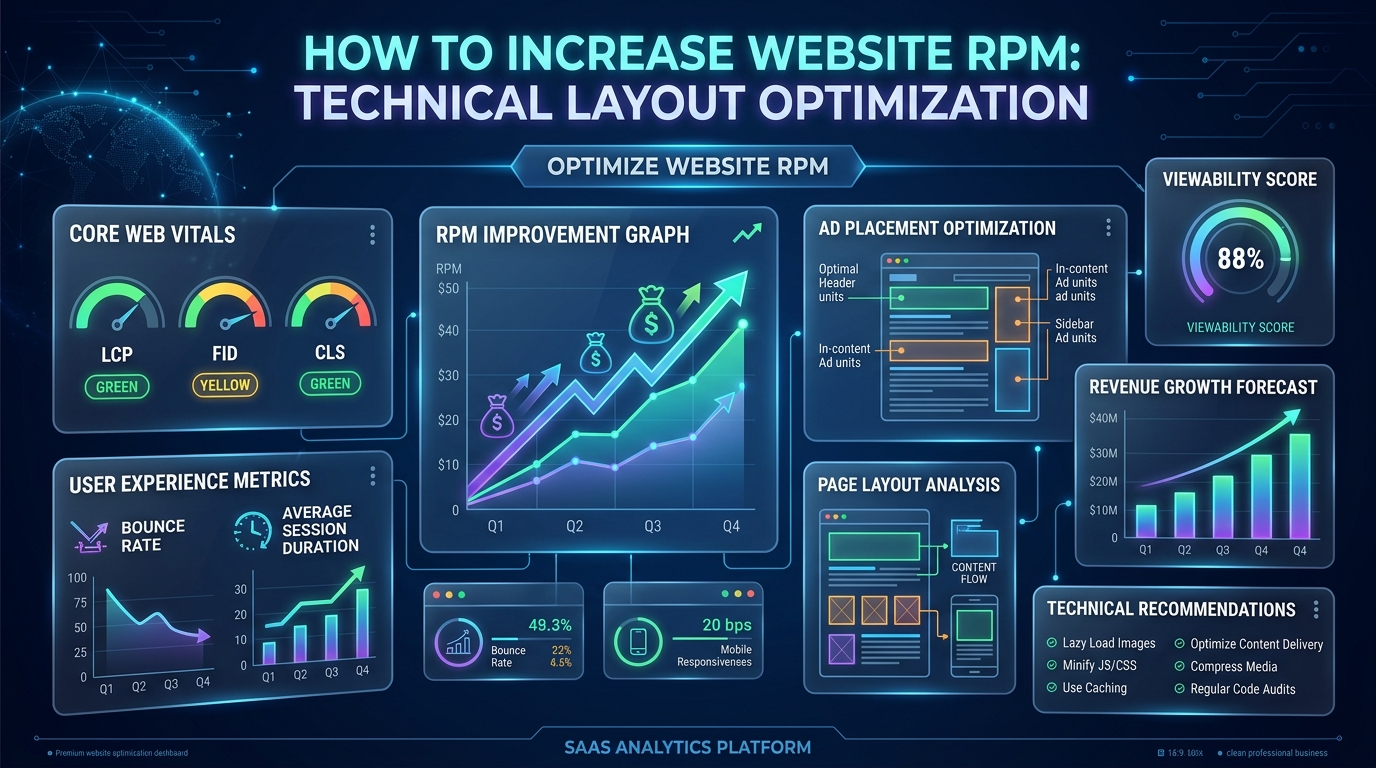
Advertisers bid more money for ads that users actually see (Viewability) and interact with (CTR). In this guide, we break down the specific layout hacks that professional publishers use to maximize their ad revenue without writing a single new word of content.
Recommended ChafikTech Tool
Why you need it: If you optimize your layout but have underlying AdSense policy violations, your RPM will remain suppressed.
How it works: The audit tool scans your setup for common configuration errors, ad density violations, and viewability issues, ensuring your technical foundation is solid before you implement advanced layout changes.
1. The Font Size and Line Height Hack
This is the simplest and most effective change you can make today. Programmatic ad networks automatically inject ads based on screen length and paragraph breaks. If your font is small, your 1,500-word article takes up very little vertical screen space, meaning fewer ads will fit.
By increasing your body font size from 16px to 18px (or even 20px) and increasing your CSS line-height to 1.7 or 1.8, you stretch your article vertically. The user now has to scroll much further to read the same amount of content. More scrolling equals more screen area, which mathematically creates space for 1 or 2 additional in-content ad units.
2. The Sticky Sidebar Ad
On desktop devices, the sidebar is a massive opportunity that most themes waste. When a user reads a long article, they eventually scroll past the initial sidebar widgets (recent posts, about me, etc.), leaving a massive blank white space on the right side of the screen.
You must implement a Sticky Sidebar Ad (a 300x600 skyscraper ad is best). As the user scrolls down the page, this ad sticks to the screen and scrolls with them. Because this ad is visible for the entire duration of the reading session, its Viewability score approaches 100%. Advertisers bid heavily on highly viewable units, making this one of the highest-paying ad slots on your entire website.
3. Lazy Loading Ad Units
If you load 5 ad units the moment a user opens your page, but they bounce after reading the first paragraph, you just generated 4 ad impressions that the user never saw. This tanks your overall Viewability score. When your site-wide Viewability score drops below 70%, advertisers lower their bids, crashing your RPM.
Enable Lazy Loading for your ads. This ensures an ad is only requested and loaded when the user scrolls close to it. You will generate fewer total ad impressions, but your Viewability will spike to 80%+. In programmatic advertising, 1,000 highly viewable impressions pay significantly more than 3,000 unviewable impressions.
4. Shorter Paragraphs for Better Injection
Google Auto Ads and premium network wrappers look for natural breaks in the HTML (like a </p> tag) to inject in-content ads. If you write massive walls of text with 8-sentence paragraphs, the algorithm cannot find a safe place to inject an ad without breaking your layout.
Break your content into 2 or 3 sentence paragraphs. This provides the ad injector with dozens of safe insertion points, ensuring you never miss out on revenue simply because your HTML structure was too dense.
5. The Anchor (Sticky Bottom) Ad
This is a horizontal ad that sticks to the bottom of the user's screen on mobile devices (and optionally on desktop). Because mobile screens are small, the anchor ad is constantly in the user's peripheral vision without aggressively blocking the content they are reading.
Anchor ads are historically the highest-performing mobile ad unit available. If you have AdSense Auto Ads turned on, ensure the "Anchor Ads" toggle is explicitly enabled. If you do nothing else for mobile optimization, do this.
Layout Strategy Comparison Table
| Layout Strategy | Impact on UX | Impact on RPM | Best Use Case |
|---|---|---|---|
| Above-the-fold Ad Heavy | Negative (High Bounce) | Temporary High, Long-term Low | Aggressive arbitrage (Not Recommended) |
| Content-First, Sticky Sidebar | Positive | High (Great Viewability) | Long-form Desktop Content |
| In-Content (Every 3-4 Paragraphs) | Neutral | Very High | Mobile-heavy traffic |
| Sticky Footer Ad (Anchor) | Slightly Negative | Extremely High | Both Mobile and Desktop |
Common Layout Mistakes
- Placing Ads Too Close to Navigation: Accidental clicks on ads placed directly under dropdown menus result in "invalid click activity" and can get your AdSense account banned.
- Ignoring Viewability: A high RPM relies on active viewability (users actually seeing the ad for >1 second). Ads buried at the very bottom of the page have 5% viewability and drag down your overall domain RPM.
Best Practices for High RPM
- Utilize Sticky Sidebars: If using a premium ad network (like Mediavine or Raptive), a sticky sidebar ad that follows the user down a long article is the highest earning desktop unit available.
- Optimize for Mobile First: 70-80% of your traffic is likely mobile. Ensure your in-content ads have adequate padding so they do not overlap text on smaller screens.
📊 Track Your RPM Growth
After implementing these layout changes, wait 14 days for the ad algorithms to adjust to the new viewability metrics. Then, plug your new metrics into the Website AdSense Calculator to see the exact financial impact of your technical optimizations.
Frequently Asked Questions
Conclusion
Before you commit to writing another 50 articles, take one weekend to audit your website's layout geometry.
Increase your font size, break up your paragraphs, implement lazy loading, and lock in a sticky sidebar. By making your site structurally friendly to programmatic ad bidding, you can permanently raise your RPM ceiling and maximize the revenue from every piece of content you ever publish.