Table of Contents
The most common question from new website owners is: "When will I actually start making money?" Unfortunately, the internet is flooded with fake gurus promising passive income in 30 days. In reality, building a website that generates consistent, meaningful AdSense revenue is a slow, methodical process that requires months of uncompensated work before the algorithm rewards you.
This guide provides a realistic, data-backed timeline for new websites in 2026. We will break down exactly what happens during the first year of a website's life, why the "Google Sandbox" delays your earnings, and when you can realistically expect your first $100.
🔧 Recommended ChafikTech Tool
As your traffic slowly grows over your first year, use the AdSense Calculator to track your trajectory. Enter your current traffic to see what you should be earning right now, and enter your 12-month traffic goal to visualize the financial finish line you are working toward.
The Concept of the "Google Sandbox"
The "Google Sandbox" is an SEO industry term used to describe a probationary period for new domains. When you register a new website, Google does not immediately trust you. For the first 3 to 6 months, Google will index your articles, but it will artificially suppress your rankings.
Why? Because spammers create thousands of new websites every day. Google forces new domains to prove their legitimacy by consistently publishing high-quality content over several months before allowing them to rank for competitive keywords. You cannot skip or hack the Sandbox; you must simply publish through it.
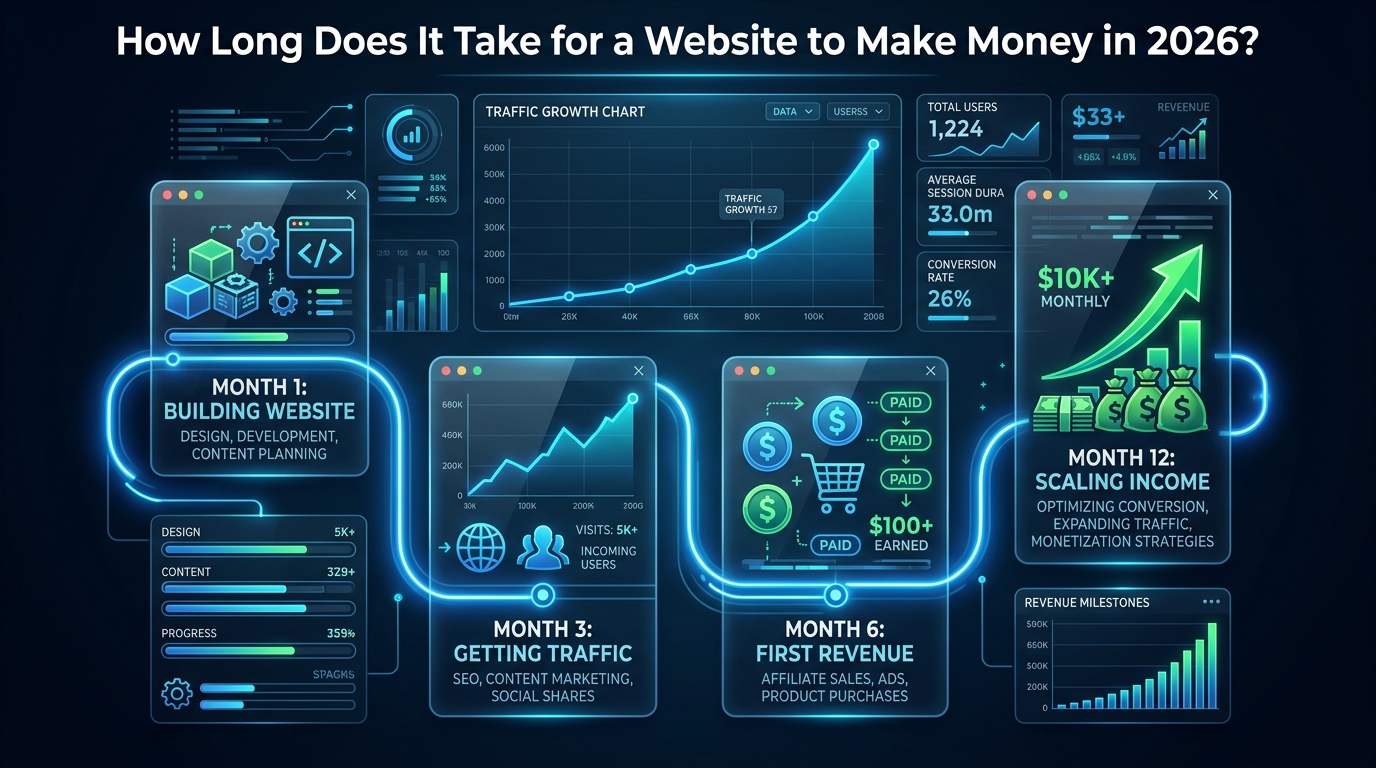
The Realistic 12-Month Website Timeline
You launch the site and publish your first 20–30 articles. Google crawls the site but ranks you on page 5 or below. Your only traffic comes from social media or direct links. Expected Traffic: 0 – 500 visitors/month. Expected Revenue: $0.
You now have 50+ articles. Google starts trusting your domain. Your ultra-low competition, long-tail keywords begin hitting page one. Traffic starts trickling in organically. You apply for Google AdSense and place your first ads. Expected Traffic: 1,000 – 5,000 visitors/month. Expected Revenue: $5 – $30/month.
You cross the 100-article milestone. Articles you published in Month 1 are finally reaching their peak ranking positions. You start earning a few backlinks naturally as people find your content. You cross the AdSense $100 payment threshold for the first time. Expected Traffic: 10,000 – 30,000 visitors/month. Expected Revenue: $100 – $400/month.
Google recognizes your site as a topical authority in your niche. New articles rank on page one within days of publishing instead of months. You have enough traffic to optimize your ad layouts for a higher RPM. Expected Traffic: 40,000 – 100,000+ visitors/month. Expected Revenue: $500 – $2,500+/month.
The 3 Factors That Accelerate the Timeline
While you cannot skip the Sandbox entirely, three factors determine whether you reach profitability in 8 months or 18 months:
- Content Velocity: A site that publishes 100 high-quality articles in its first 3 months will exit the Sandbox much faster and with much higher traffic than a site that publishes 1 article per week. Volume combined with quality is the ultimate accelerant.
- Keyword Difficulty Selection: If a new site targets keywords with a Difficulty Score of 50, it will not rank for years. If it targets ultra-specific keywords with a Difficulty Score of 0-10 (the Keyword Golden Ratio method), it can generate traffic even while inside the Sandbox.
- Niche RPM: If you are in the finance niche (RPM $35), you only need 3,000 visitors to make your first $100. If you are in the gaming niche (RPM $2), you need 50,000 visitors to make that same $100. High RPM niches require less traffic to achieve profitability.
The "Content Aging" Phenomenon
A crucial concept to understand is that SEO traffic is a lagging indicator of your effort. An article published today will not reach its maximum traffic potential for approximately 6 to 8 months. Google tests the article in various positions, gathers user engagement data, and slowly moves it up the rankings if the data is positive.
This means the revenue you earn in Month 8 is the result of the articles you wrote in Month 2. If you stop publishing in Month 4 because you "aren't making money," you are abandoning the project right before the delayed results begin to compound.
Month-by-Month Realistic Expectations
Understanding what to realistically expect prevents burnout and premature abandonment. Here is an honest breakdown:
- Months 1–3: Zero AdSense revenue. Google is indexing your content. Focus entirely on publishing 2–3 articles per week targeting low-competition, long-tail keywords.
- Months 4–6: First trickle of organic traffic. You may reach 100–500 monthly visitors. Apply for Google AdSense (requires 500+ monthly visitors minimum in most regions). Expect $0–$5/month.
- Months 7–12: If your content is consistent and targeted, you may reach 2,000–5,000 monthly visitors. AdSense earnings: $20–$80/month depending on niche RPM.
- Year 2+: Compounding effect. Articles published in months 1–6 begin ranking for secondary keywords. Traffic can reach 10,000–50,000/month. This is when monetisation becomes meaningful ($200–$1,500/month).
Niche Speed Comparison Table
| Niche | Competition Level | Avg. Time to First $100/mo | Avg. RPM |
|---|---|---|---|
| Finance & Investing | Very High | 18–24 months | $20–$45 |
| Technology (B2B) | High | 12–18 months | $15–$30 |
| Health & Wellness | High | 12–18 months | $10–$25 |
| Niche Hobbies | Low | 6–12 months | $3–$8 |
| News / Viral | Extreme | Unpredictable | $1–$4 |
Common Mistakes
- Expecting income in Month 1: Google's "sandbox" period for new domains can delay rankings for 3–6 months regardless of content quality.
- Broad Keyword Targeting: Writing about "best smartphones" as a new site guarantees you will never rank. Target "best smartphone for elderly parents with large buttons" to win your first traffic.
- Quitting at Month 5: This is statistically the most common quit point — precisely when the compounding effect is about to kick in.
Best Practices
- Track Weekly, Judge Annually: Review your SEO metrics weekly but evaluate success on a 12-month basis.
- Build Backlinks Proactively: Guest posting, HARO (Help a Reporter Out), and digital PR accelerate the timeline by building domain authority faster.
- Diversify Revenue Early: Add affiliate links from month one. Affiliate income does not require the traffic volume that AdSense does.
📊 Project Your Future Revenue
Use the ChafikTech Website AdSense Calculator to model your expected monthly earnings at different traffic milestones. This prevents guesswork and helps you set concrete, measurable goals.
Frequently Asked Questions
Conclusion
Building a profitable website is not a get-rich-quick scheme; it is the construction of a digital asset. The 12-month timeline filters out 90% of beginners who quit when they don't see immediate results in month three. If you commit to publishing high-quality, low-competition content consistently for a year, the math works in your favor. Calculate the potential value of that 12-month finish line using our Website AdSense Calculator, and let that projection keep you motivated through the quiet early months.