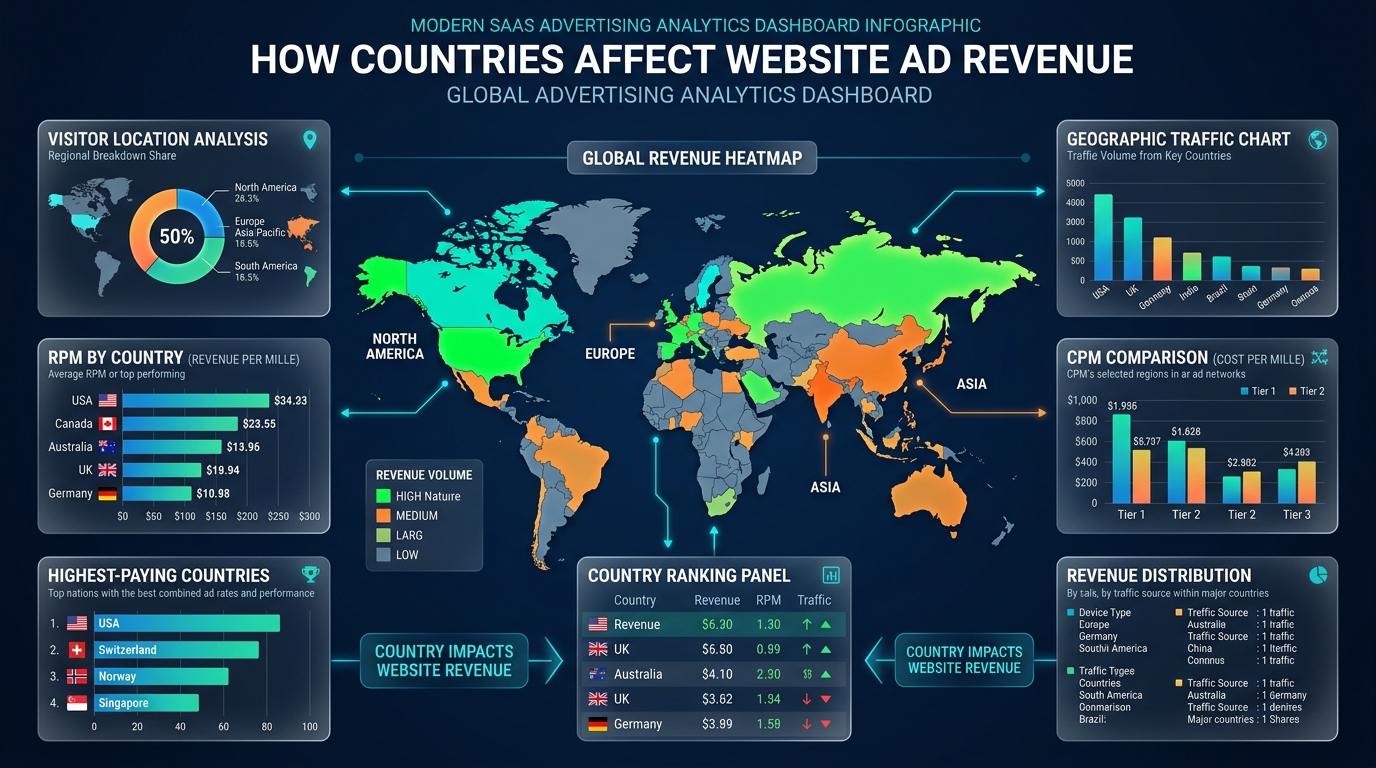
A webmaster in the United States and a webmaster in India start identical blogs about smartphone reviews. After six months, both blogs receive exactly 50,000 pageviews a month. The US webmaster makes $800 from AdSense. The Indian webmaster makes $60 from AdSense.
Is the algorithm biased? Is Google stealing money? No. The vast discrepancy in their paychecks is entirely due to the geography of their audience. Let's explore exactly why audience location is the single most critical factor in website monetization.
The Reality of Advertiser Demand
To understand why geography dictates revenue, you must understand the mindset of the advertiser. Corporations do not buy ads for fun; they buy ads to acquire customers who will spend money.
A multi-national tech company selling a $1,200 laptop knows that the average consumer in the United States, United Kingdom, or Australia has the disposable income to make that purchase. Therefore, the company will bid $2.50 per click (CPC) to show their ad to a user in New York.
That same tech company knows that the average consumer in a developing nation cannot afford a $1,200 laptop. Therefore, they tell Google AdSense to exclude that country from their ad campaign. As a result, the only advertisers left bidding on the developing nation's traffic are local businesses with tiny marketing budgets, resulting in a CPC of just $0.02.
Simulate Geographic Traffic Shifts
Curious how much your income would change if you shifted your audience? Open our Website AdSense Calculator. Set the RPM to $15.00 (Tier 1 US Traffic) and calculate the revenue. Then, set the RPM to $1.50 (Tier 3 Global Traffic) and run it again. You will immediately see why geography targeting is mandatory.
How to Target High-Paying Countries
If you live outside of a Tier 1 country, you are not doomed to low AdSense earnings. The beauty of the internet is that you can build a website that targets a foreign audience. Here is the blueprint for localization:
1. Write in English
This is the non-negotiable first step. The highest AdSense RPM countries in the world (US, UK, Canada, Australia) are primarily English-speaking. If you write your blog in Spanish, Hindi, or Arabic, you immediately cut yourself off from the majority of Tier 1 ad budgets.
2. Cultural Formatting
If you want to capture US traffic, your website must feel like it was built in the US. This means:
- Using Imperial measurements (inches, pounds, miles) instead of Metric.
- Pricing all products in USD ($), not local currency.
- Referencing US-centric concepts (e.g., mentioning "tax season in April" or "Thanksgiving sales" instead of local holidays).
- Using US English spelling (e.g., color vs colour, optimize vs optimise).
3. Server Location and TLDs
Google considers the physical location of your website when serving search results. If you want to rank in Google USA, host your website on a server located in North America (like DigitalOcean NYC or AWS US-East). Furthermore, use a generic Top-Level Domain (like `.com` or `.net`) rather than a country-specific TLD (like `.co.in` or `.co.uk`).
The Myth of the VPN
A common misconception among beginner website owners is that they can use a VPN to "trick" AdSense into thinking their traffic is from the US. This does not work. Google's ad network is sophisticated enough to detect proxy IPs, data center traffic, and VPN nodes. Attempting to manipulate audience location will result in permanent account suspension for Invalid Traffic.
Benchmark Your Geographic Revenue
Curious how your current country mix compares to global averages? Visit our RPM Data by Country page for live benchmarks across platforms. If you suspect your AdSense revenue is lower than it should be for your geography, run your site through the AdSense Audit Tool to rule out policy issues. Not yet monetized? The AdSense Eligibility Checker will tell you if your site qualifies.
Frequently Asked Questions
Q: If I write in English, will I automatically get US traffic?
A: Not automatically. Writing in English makes you eligible for US traffic, but you still need to rank in Google USA (google.com, not country-specific versions). This requires US-targeted keyword research and potentially server hosting in North America.
Q: Can I target multiple high-paying countries at once?
A: Yes. The "Big Four" — US, UK, Canada, Australia — are all English-speaking and culturally similar enough that content targeting one typically ranks in all four. This is the ideal strategy: write one piece of content and capture four Tier 1 markets simultaneously.
Q: Why do Nordic countries pay well despite their small population?
A: Scandinavia has among the highest average income and digital maturity in the world. Advertisers targeting affluent consumers (luxury goods, financial products, premium SaaS) bid extremely high for Scandinavian eyeballs, resulting in CPCs that can rival or exceed the US in certain niches.
Q: Does GDPR affect my earnings from EU traffic?
A: Significantly. GDPR requires explicit consent before personalized ads can be shown. Users who decline consent see only generic, non-targeted ads, which carry much lower CPCs. This is why many publishers see their EU traffic generating 30–50% lower RPMs than comparable US traffic.
Q: My Google Analytics shows 60% US traffic but my RPM is still low. Why?
A: Geography is only one factor. Even with 60% US traffic, a low-CPC niche (entertainment, general news) will produce low RPMs. You need both high-value geography AND a high-value niche to achieve premium RPMs consistently.
Q: How can I increase my percentage of US traffic from my current audience?
A: Conduct keyword research specifically using a US-based VPN or by checking Google Search Console data filtered to the US. Identify keywords where US users significantly outperform your current ranking. Publish content targeting those specific queries and backlink from US-based sites.
Q: Is it ethical to optimize for US traffic if I am not based in the US?
A: Completely. The internet is borderless by design. Millions of international publishers build English-language websites targeting US audiences. This is standard professional practice in digital publishing, not deception.
Q: Does ad language affect my RPM by country?
A: Yes. If you have multilingual content on the same domain, AdSense will try to show ads in the user's language. Spanish-language content showing Spanish ads will have a lower RPM than English-language content on the same domain, even if the physical user is in the US.
Conclusion
Traffic is a vanity metric. Generating 100,000 pageviews from countries with low advertiser demand is a waste of server space if your goal is monetization.
If you want to build a profitable website, you must treat your content like an export business. Build a high-quality product in your home country, but optimize every single keyword, paragraph, and formatting choice to appeal directly to the consumers in the highest-paying markets in the world.